Can You Use a Camera Tripod for a Telescope? What Works and What Wobbles
You can use a camera tripod for a telescope, but binoculars and spotting scopes usually wobble less because they’re lighter.
At high magnification, small movement in the head or legs blurs the view.
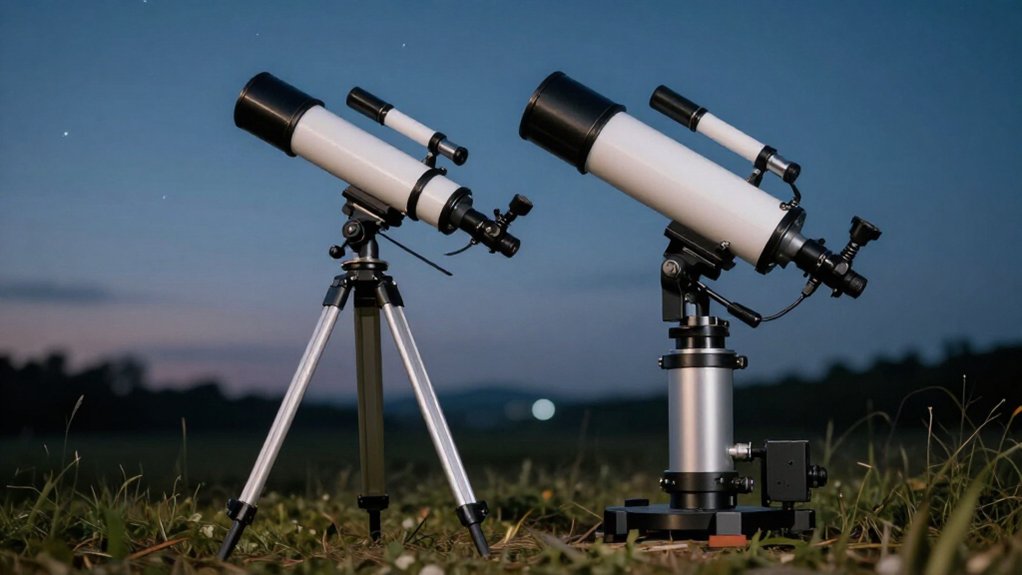
A long 70mm refractor aimed at the zenith shifts leverage and can strain a light head.
Wind and extended thin legs worsen shake.
Check the complete rig against payload limits; carbon-fiber legs won’t fix flex.
The sections ahead cover practical setup checks.
Can a Camera Tripod Handle Binoculars Better Than a Telescope?
Yes. Binoculars and spotting scopes are lighter, so a photo tripod often holds them steadily. A telescope adds the optical tube and mount, which can push a camera tripod beyond its rated capacity. At high magnification, small vibrations make a telescope’s image wobble or blur more noticeably than binocular views.
Because they’re lighter, binoculars and spotting scopes often work well on camera tripods, but telescopes place greater demands on the whole setup. A binocular rig carries a modest load, so a photo tripod can hold it steadily.
A telescope adds the optical tube and mount, pushing a camera tripod beyond its rated capacity. You’ll notice the difference at high magnification: small vibrations that affect binoculars less can make a telescope’s image wobble or blur. Wind or a knock can keep an undersized system shaking, and a heavy tube can shift the balance, reducing steadiness.
Check the telescope-and-mount weight and damping performance; don’t rely on weight rating alone. Unless your tripod was built for telescope use, choose an astronomical tripod to support the load and preserve sharp views.
Will a Camera Tripod Head Work With a Telescope?
A ball or tilt head can aim binoculars and spotting scopes, but a telescope needs a rigid, secure connection to control motion. Check the head’s rating against the telescope’s weight and leverage, because capacity alone doesn’t ensure stability. If it can’t hold the load, choose an astronomical tripod.
A camera tripod’s ball or tilt head can aim binoculars and spotting scopes, but a telescope needs a rigid, secure connection to control motion. Check the head’s rating against the telescope’s weight and leverage; capacity doesn’t ensure stability.
At high magnification, small head movement becomes a shake, so compare connection rigidity, not just payload figures.
| Head type | Typical use | Telescope concern |
|---|---|---|
| Ball | Quick aiming | Flex |
| Tilt | Alt-az aiming | Wobble |
| Astronomy mount | Telescope support | Rigid |
Skip rubber or cork spacers between the head and plate; removing them can make the interface more rigid. Astronomical tripods balance mount, head, and telescope as a system. Camera heads may not secure optics steadily, despite sturdy legs.
If your head flexes, choose a rigid compatible mount over unstable views.
Can a Camera Tripod Hold a 70mm Refractor Pointed at the Zenith?
It is risky. Head rigidity matters even more when you point a 70mm refractor at the zenith, because its long tube puts extra leverage on a camera tripod and raises the risk of flex or tipping. Check the head’s rating against the tube’s weight, and consider an astronomical tripod if in doubt.
Head rigidity matters even more when you point a 70mm refractor at the zenith: its long tube puts extra leverage on a camera tripod, raising the risk of flex or tipping.
A light ball head may carry the scope on paper, yet the tube’s leverage can exceed safe capacity and shift the center of mass toward a tip. At high magnification, small vibrations at the tripod-head joint become obvious; wind at full height makes control worse.
A typical camera head may also drift or bind instead of tracking smoothly. If you must use one, choose a secure alt-az mount or suitable tilt head, keep the legs short, and level the base carefully. That low setup damps vibration better than extending thin sections.
For steady views, an astronomical tripod matched to the telescope’s weight is the better choice. Camera tripods suit low-power binoculars or spotting scopes more readily than a refractor aimed overhead under these conditions.
Do Carbon-Fiber Tripod Legs Reduce Telescope Vibration?
Carbon-fiber legs cut carrying weight and often feel stiffer than aluminum, but they don’t eliminate vibration. For sharper views, keep the mount within its load rating, tighten the head connection, and extend the thicker leg sections first, using the thinner sections only as much as you need.
Carbon-fiber legs cut carrying weight and often feel stiffer than aluminum, but they don’t eliminate vibration. For sharper views, keep the mount within its load rating, tighten the head connection, and extend the thicker leg sections first.
In wind, lowering the tripod usually steadies the image more than changing leg material.
Lightweight Portability
The weight savings of carbon-fiber legs make a tripod easier to carry, but don’t assume they can safely support a telescope.
Carbon fiber cuts carry weight, helping on hikes. Yet portability doesn’t increase load capacity. A telescope’s optical tube and counterweights can exceed a camera tripod’s rating. Check the payload limit for the setup, and leave a safety margin.
Inspect the head, plate, and adapter too: a flexible interface can undermine otherwise capable legs. Wind also affects a light setup more readily, so choose a sheltered location or add weight at the center when the design allows. Keep the legs low, extend thicker sections first, and level carefully. Treat carbon fiber as a borderline option; a purpose-built astronomical tripod handles telescope loads more reliably.
Vibration Damping
Although carbon-fiber legs are light and stiff, high magnification reveals tremors from wind or handling. At telescope focal lengths, even a tiny shake can turn a crisp target into a quivering blur.
Extend lower leg sections sparingly; save thinner sections for last, using them only when needed. In gusts, keep the tripod low: lowering its center relative to the observing air column helps vibration fade faster, though you’ll trade away some stability margin.
| Setup | What you’ll notice |
|---|---|
| Legs extended | Longer, slower shake |
| Tripod lowered | Gusts settle sooner |
| Soft spacer | More head movement |
| Tight plate | Less lingering blur |
Skip rubber or cork spacers between head and plate; their compliance can prolong motion. Screw the plate down securely. After a bump or gust, wait for the image to settle before observing; vibrations won’t cancel reliably at telescope focal lengths. Quick settling protects the moment you’ve found your target.
Stiffness Under Load
Because stiffness depends on more than the leg material, carbon-fiber tripods can still flex under a telescope’s load. The joints and leg extension matter just as much. For better support, extend the thickest sections first and the thinnest sections last; thin extensions damp vibration less and can make high-magnification views jitter.
Long, thin sections may also cause measurable wobble and longer settling times, particularly when your telescope and head make the setup front-heavy. Keep the tripod lower when practical to improve damping. Rigid carbon legs won’t prevent vibration if your optics exceed the rated payload or spacers allow components to shift.
After a gust or bump, stiff legs can settle faster than flexible ones; but only when you keep them short and firm, with secure ground contact.
How Does Wind Affect a Camera Tripod Holding a Telescope?
At high magnification you’ll see gust-driven movement, and wind or a knock can keep an undersized setup shaking. Keep the tripod low, extend thin leg sections only as needed, and use a hanging weight to steady it. Compare how quickly your setup settles after a jostle.
At high magnification, you’ll see gust-driven movement, so compare how quickly your setup settles after a jostle. Keep the tripod low and extend thin leg sections only as needed; a hanging weight steadies it better than holding it.
Use a timer or remote trigger to avoid adding shutter shake while the mount settles.
Wind-Induced Movement
Even a light breeze can make a tripod-mounted telescope wobble, since gusts flex the legs and head and small vibrations become obvious at higher magnifications, softening the view. At high power, a gust can turn a target into a wavering, soft image; a tripod generally reacts more than a heavier, stiffer mount. Keep the legs short and avoid extending their thinnest sections.
In exposed conditions, hang a bag from the setup to add ballast, rather than gripping the tripod, which transfers your shifting weight. Trigger the shutter with a timer or remote and stand clear. After a gust or bump, pause until the image steadies before continuing.
| Setup | Wind response |
|---|---|
| Raised, thin legs | Flexes readily |
| Lower, thicker legs | Resists flex better |
| Hand on tripod | Adds tremors |
| Hanging bag | Adds stability |
Vibration Settling Time
After a gust or bump, wait for the tripod’s vibration to die down before triggering the exposure; tremors decay gradually, and higher magnification makes even small movements visible. At higher power, you’ll notice a tripod’s motion more readily than at low power, so judge settling through the telescope’s view. Lowering the legs usually shortens the wait because shorter sections flex less, but keep a broad stance and choose firm ground; a low, narrow setup can still wobble.
In wind, extend only the thicker leg sections you need. Compared with a fully extended tripod, a lower setup settles sooner, though the surface and head affect the result. Exposure length changes how clearly shake appears: longer exposures may tolerate slight motion, while short ones reveal it sharply.
Reducing Exposure and Shake
Once vibrations have settled, wind can still blur a high-magnification view by continually jostling the telescope. Lowering the tripod improves damping, though you’ll sacrifice height and may reduce leg spread stability. Extend the thickest leg sections first; extend thin sections last, and only as far as necessary.
On soft ground, improve contact by setting feet or using spikes where suitable, so the base doesn’t shift with gusts. Don’t hold or grab the tripod during exposure: your touch adds micro-movements. Instead, use a timer delay or external shutter release to avoid hand shake and shutter shock.
If wind still drives wobble, hang a weight or bag from the tripod; that can calm motion without blur caused by bracing it by hand.
Can You Photograph the Moon Through a Telescope on a Camera Tripod?
Yes. Mount a phone adapter or astronomy eyepiece clamp on the tripod and photograph the Moon through the telescope at low magnification first. A phone clamp holds your camera over the eyepiece, and a T-ring may align it more firmly. Keep the tripod low and lock the legs and head.
Mount a phone adapter or astronomy eyepiece clamp on the tripod to photograph the Moon through a telescope at low magnification first. A phone clamp holds your camera over the eyepiece; a T-ring may align it more firmly, depending on your telescope. Keep the tripod low and lock legs and head.
The Moon’s bright edge reveals small shakes; higher phone zoom magnifies them. Use level ground: uneven terrain can twist or slip under telescope weight. If the phone mount pulls forward, reposition it or counterbalance safely to keep the center of gravity near the tripod head.
Start recording with a timer, remote, or wireless trigger, then keep your hands off the tripod. Phone capture adds alignment and balance demands compared with eyepiece viewing.
Can a Camera Tripod Handle Long-Exposure Astrophotography With a Telescope?
Not reliably. Phone capture through an eyepiece can tolerate brief shake, but long exposures record even small movements as star trails. At high magnification your smallest tremor becomes measurable blur, and wind, footsteps, or shutter and mirror shock can smear stars during the exposure.
Phone capture through an eyepiece can tolerate brief shake, but long exposures record even small movements as star trails. At high magnification, your smallest tremor becomes measurable blur, and wind, footsteps, or shutter and mirror shock can smear stars. A setup that settles slowly may look acceptable for brief viewing yet fail during long exposures; longer integration gives disturbances more time to spoil point sources.
Keep the tripod low and extend only what’s necessary. Thin extended sections flex more, so they transmit wind-driven motion more readily than a compact stance. Balance the camera, telescope, and adapters around the head; a front-heavy arrangement can increase settling time after a bump. Don’t add rubber or cork spacers between tripod and head: their compliance can turn movement into trailing.
Why Do Payload Ratings Matter When Mounting a Telescope on a Tripod?
Treat the tripod’s payload rating as a safety limit, not a suggestion. A telescope, counterweights, and heavy optics can exceed what a camera tripod is built to carry. Check the combined weight of the complete rig against the rating, because carbon-fiber legs won’t fix flex.
Treat the tripod’s payload rating as a safety limit, not a suggestion: a telescope, counterweights, and heavy optics can exceed what a camera tripod is built to carry.
A camera-rated stand, especially one intended for binoculars, may flex or tip under that load. Compare its rating with the complete rig, not the optical tube alone:
- Include counterweights, diagonal, eyepiece, and finder.
- Expect high magnification to reveal tiny mount motions as large image shifts.
- Recognize that excess load weakens vibration damping, even without a visible failure.
- Check the head: ball and tilt designs aren’t built for slewing torque and can loosen, causing drift or wobble.
An astronomy tripod matched to an EQ-5/HEQ5 handles these loads more securely. Overload can cause sudden collapse or drift.
What Should You Pack to Keep a Tripod Tight in the Field?
Pack a small hex-key set. Even a tripod within its payload limit can loosen after a bump or gust, so keeping a hex key in your kit lets you re-tighten connections on the spot. Check the tripod again after any knock before you resume viewing or shooting.
Even a tripod within its payload limit can loosen after a bump or gust, so keep a small hex-key set in your kit.
Many camera tripod heads and telescope mounts use Allen bolts to lock the head, attach plates, and adjust angles. Carry 2, 2.5, 3, 4, and 5-mm keys; matching the fastener prevents stripping it while you secure the tripod-head interface. Use them to remove or adjust spacers and plates when improving stability: your head should screw into the tripod, rather than depend on rubber or cork.
After a knock or wind gust, you can quickly re-level and retighten joints before vibration damping degrades. The same kit often fits an astronomical mount, helping you install adapters, tighten slow-motion controls, and secure telescope rings.
Conclusion
A camera tripod can support a telescope, but only when its head, legs, and rated payload suit the optical tube. Binoculars and phone-adapter Moon viewing demand less stability; a 70mm refractor near the zenith exposes weak heads and flexing legs.
Carbon fiber reduces carry weight, not vibration, and wind still matters. For long-exposure astrophotography, use a tracking mount. Check payload ratings, tighten fittings with a hex key, and choose the stiffer setup over the lighter one.