What Tripod Weight Capacity Do You Need? The Camera + Lens Payload Rule
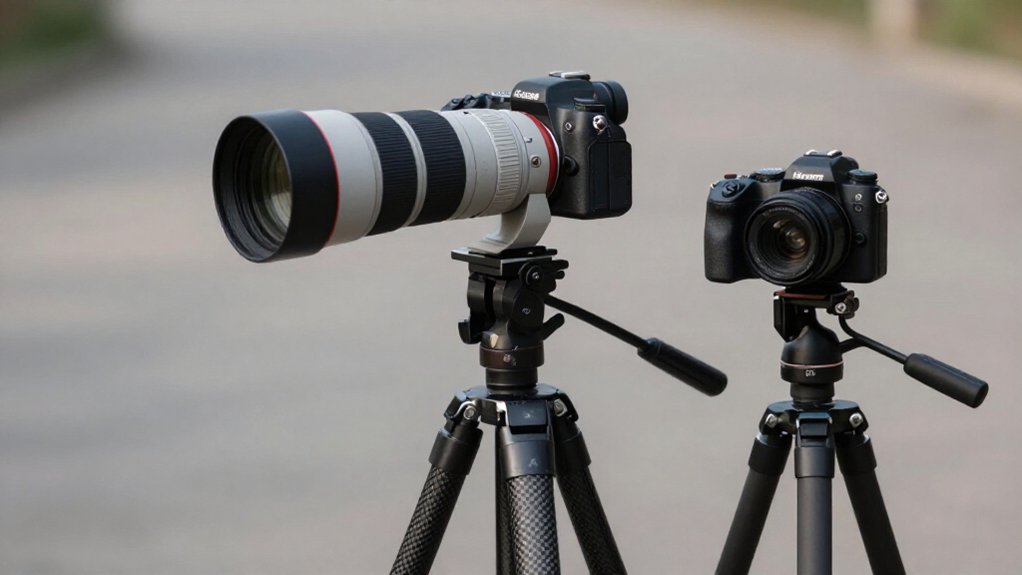
Choose tripod legs and a head rated for two to three times your heaviest fully mounted setup.
Weigh the camera, lens, head, and every attached accessory, including grips, monitors, or brackets.
For a five-pound kit, target a 10–15-pound rating; outdoors, favor three times the load.
A larger margin helps resist vibration and head creep, though ratings don’t guarantee stability on extended legs or uneven ground.
Next, compare these factors when choosing your tripod carefully and systematically.
3x Payload Safety Rule
To preserve sharpness, choose tripod legs rated for about 2–3× the total weight of your camera, lens, head, and required accessories. For example, if your heaviest mounted setup weighs 5 lb, select legs rated for 10–15 lb. That overhead helps absorb small vibrations from wind or accidental contact, preserving image sharpness. It also reduces the chance that your ball head will creep or slide after you tighten its knob.
Account for leverage, too: a heavy lens extends the load away from the tripod’s center, placing more stress on the support than camera-body weight alone suggests. Outdoors, aim closer to 3×; optimistic manufacturer ratings and unstable conditions leave less margin for motion. Use the higher rating when your setup faces frequent wind or ground movement.
Weigh Camera, Lens, Accessories
Before applying the 2–3× safety rule, weigh the full mounted setup: camera, heaviest planned lens, tripod head, brackets, and accessories such as a battery grip, flash, or monitor. Use the heaviest lens you expect to mount as your anchor, then include the camera body and every component attached during shooting.
The lens’s leverage can increase stress on the head, leg locks, and joints, even when the body weighs little. Add an L-bracket or vertical-shooting hardware, battery grip, flash, and external monitor; each adds load and can increase torque or sensitivity to vibration. Include the tripod head in your calculation because its mass also rests on the legs.
Weigh the assembled kit on a scale, or weigh components separately and sum them. If you may add a heavier lens or monitor later, calculate that future maximum now. Use this complete payload, not the body-only figure, when selecting capacity. Check the manufacturer’s stated rating against this total.
Carbon Fiber vs. Aluminum
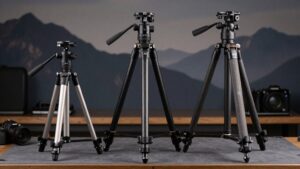
Carbon fiber reduces carry weight, damps vibration faster, and performs better in cold weather, making it a strong choice for outdoor travel. You’ll carry less while its stiff legs settle quickly, helping protect sharpness in wind. Aluminum costs less and adds mass, but its legs can ring like a tuning fork and vibrate longer. That behavior may soften images in windy conditions, though aluminum suits controlled, static setups.
| Factor | Carbon fiber | Aluminum |
|---|---|---|
| Carry and damping | Lighter; settles faster | Heavier; rings longer |
| Best fit | Outdoor travel | Controlled, static use |
Whichever material you choose, size capacity for your mounted camera, lens, and accessories: target a rating around two to three times their combined weight for stability. Check the rating with accessories included.
Ball-Head Versus Fluid-Head Tradeoffs
Head ratings and usable payload differ, so you should size the head and legs for your camera, lens, and head weight, with a 2–3× capacity margin for sharper, steadier results.
A ball head gives you fast positioning; use friction and lock controls to prevent a heavy lens from flopping, and choose a ball size suited to your load. For video, a correctly rated fluid head provides smooth, resisted motion, so match the head to your shooting style and payload.
Payload Ratings Differ
A tripod’s load rating doesn’t tell you how much its head can safely support, so check both ratings against your camera, lens, and accessories. Strong legs can’t offset an undersized head, the likely failure point.
For a ball head, match ball size and friction control to weight: 30–36 mm balls often suit setups under 3 kg, while 40 mm-or-larger models with friction control handle about 3–5 kg. A fluid head needs counterbalance and drag tuning; an out-of-range setup can feel sluggish or unbalanced.
For either type, choose leg and head ratings about two to three times your heaviest camera, lens, and accessory total to limit creep and preserve sharpness. Wind and vibration can challenge you outdoors, so respect each head’s weight and torque limits.
Ball Heads Prioritize Speed
Ball heads usually offer the fastest repositioning for stills, but size one so its rated capacity comfortably exceeds your camera-and-lens load to prevent creep or flopping.
For a setup weighing about 3–5 kg (6.6–11 lb), choose a medium-large ball head, often with a ball around 40 mm or larger. Check that its rating covers the camera, lens, and head, not just the camera-and-lens payload. A friction control knob helps keep the camera from dropping when you loosen the main lock.
For best stability, target two to three times capacity overhead at both head and legs relative to the kit; this margin helps resist wind and vibration and limits movement that can soften images. For video, match a fluid head’s counterbalance to your lens weight.
Fluid Heads Smooth Motion
When your framing requires smooth motion, choose a fluid head: its internal oil provides steady pan-and-tilt resistance, while a ball head’s compact, versatile design suits stills and general use. With a ball head, you set friction and lock the camera in position; a fluid head lets you pan or tilt with controlled, steady movement and fewer abrupt shifts.
For video, check the head’s counterbalance rating against your complete camera rig. An underspecified rating can let a lens drift or jerk as you move, while suitable balance supports consistent motion.
Include head weight when sizing the tripod: the legs carry the camera, lens, and head together. Compare that total payload with the tripod’s rated capacity, rather than counting camera and lens alone, for accurate sizing.
Match Head to Shooting Style
For most still photography, choose a compact ball head, but make sure it has a friction control knob to prevent a heavy camera-and-lens setup from flopping when you loosen the main knob.
Systems weighing about 3–5 kg (6.6–11 lb) need a medium-to-large ball head, typically with a 40 mm-or-larger ball, to resist creep and hold framing. Wildlife or telephoto work with frequent reframing may suit a rated gimbal head, which balances the lens for smooth movement.
For video, choose a fluid head with counterbalance suited to your rig; damping smooths pans and tilts while limiting overshoot and jitter. The head often fails first, so match its capacity to your shooting style and heaviest payload. Choose a margin above the load, not the bare minimum.
Tripods for Travel and Hiking
For travel and hiking, size tripod legs for two to three times your heaviest mounted payload, including the camera, lens, head, and accessories.
Compare folded length and materials: carbon fiber typically damps vibration faster than aluminum, while extended legs and wind or uneven ground can reduce stability below the rated capacity. If you carry lightweight gear, prioritize firm locks and reliable footing on soft ground over excess capacity.
Lightweight Tripod Materials
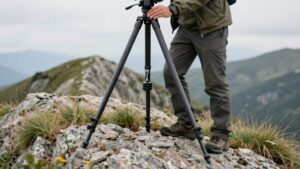
On hikes, carbon-fiber legs provide a useful balance of low weight and stiffness, damping vibration quickly when a tripod gets bumped on uneven ground. That damping can help preserve sharpness after an impact, but material alone doesn’t guarantee stability.
Choose rated capacity around two to three times your heaviest mounted setup, including camera, lens, and head, to retain a margin in wind. For leg stiffness, Series 1 (~22 mm) suits light mirrorless or action builds, while Series 2, around 28 mm, is the sweet spot for a pro body and standard zoom.
Check the head too: a ball head with friction control can support tilting without becoming the weak point. Carbon fiber costs more than aluminum; weigh that expense against carry weight and vibration control.
Compact Folded Size
A travel tripod’s folded length and section design determine how easily it fits in a pack without forcing you to leave essential gear behind. Choose a compact folded model whose length fits your pack without obstructing access to gear. Fewer, larger leg sections can simplify setup and reduce the number of joints you must lock on a trail.
Check the folded dimensions, not just the tripod’s height, and account for the head, since it may add length or snag gear. For hiking routes with narrow passages, a profile that’s easy to carry and stow helps. Carbon fiber legs can limit carried weight and damp vibration when you extend them at exposed viewpoints.
Select a compact configuration that balances packability with setup speed.
Match Capacity to Gear
Match the tripod’s leg-and-head rated capacity to your heaviest camera-and-lens setup, including the head’s weight in the load calculation. For a hiking kit, add your camera, lens, and attached accessories to find the payload; include the head rather than comparing the camera alone.
Use the 3x rule: multiply that combined gear weight by two to three to set a target rated payload. This margin helps keep your setup within the tripod’s effective limit. For scale, a 159-gram GoPro HERO13 or 203-gram Insta360 X4 sits far below the roughly 5-kilogram rating of many TELESIN tabletop tripods; don’t treat that excess capacity as a reason to skip checking your complete kit. Leave room for upgrades: a larger lens, L-bracket, or monitor adds load and may approach the tripod’s effective rated payload.
Balance Stability and Portability
For travel and hiking, choose a tripod whose rated leg capacity is two to three times the combined weight of your camera, heaviest lens, accessories, and head. Include the head in your payload calculation; its weight loads the legs even though you may think first of the camera body and lens.
For a five-pound camera, lens, and accessory setup, select legs rated for roughly 10–15 pounds, adjusting the total to include the head.
Choose carbon fiber for hiking to reduce pack weight while retaining stiffness and faster vibration damping. It doesn’t replace capacity margin. In wind, uneven dirt, or tilted outdoor compositions, aim near the three-times end rather than the minimum. Check length and capacity before packing; a lighter model still needs adequate leg-load headroom.
Quick-Release Plate Compatibility
Before relying on a tripod’s rated capacity, confirm its head’s quick-release clamp matches your camera’s plate system, such as Arca-Swiss or Manfrotto-compatible. That interface determines whether the camera and lens mount securely; a high payload rating can’t compensate for a plate the clamp doesn’t accept.
Check the kit contents, since some tripod sets include legs and a head but require you to purchase the plate separately. Verify the plate’s length and thickness, then confirm the clamp locks firmly around that plate. Check for movement as you change angles.
If you use an L-bracket for vertical framing, confirm it attaches to the same quick-release system without improvised adapters. Keeping a compatible standard across your tripod, monopod, and gimbal lets you transfer your camera without changing mounting hardware.
Replacement Parts Availability
When evaluating tripod capacity, check whether the manufacturer or authorized retailers sell documented replacement parts for the specific model, such as leg clamps, center-column sections, and head hardware.
Before purchase, review parts diagrams and replacement SKUs; match each component to your leg-section count and center-column design, since similar models may not share parts. Prefer standardized fasteners and listed components, and verify stock rather than relying on one-off items; support differs across compact outdoor and professional models.
If you use a separate head and quick-release plate, confirm you can replace the plate or head interface independently. A bent section or worn clamp can reduce stability and your effective safety payload. Access to the replacement helps restore the tripod’s original stability margin without replacing the system.
Plastic Leg Locks
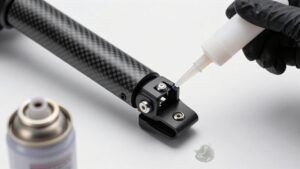
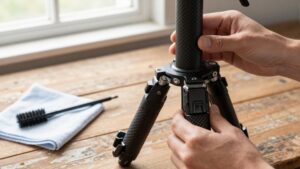
Replacement-part support matters, but the locks themselves also affect how much payload a tripod can hold reliably. Plastic locks must resist bending as you extend legs, particularly with your camera-and-lens payload raised. A loose clamp can let a leg creep under load, softening images even when the stated rating appears ample.
Check these factors:
- Cold temperatures can reduce plastic grip.
- Repeated tightening may round lock faces and weaken clamping.
- For wind or tilt outdoors, keep your payload near 50–70% of the tripod rating.
- Choose metal or reinforced locks for heavy setups and long lenses, whose leverage increases stress.
Plastic-lock failure can precede the legs’ theoretical payload limit, so judge the locking hardware, not just the printed capacity, when matching support to your equipment and conditions.
Verify Center-Column Hook Stability
A center-column hook can improve stability, but it doesn’t guarantee less sway, especially on soft dirt, sand, or uneven rock. Check the hook’s published load rating, then apply the camera-and-lens payload rule first: choose a tripod rated at two to three times your payload for maximum sharpness.
- Seat the center column fully; check for wobble where it meets the head.
- Add hook weight only within published hook and leg limits; use it to counter wind or tilt, not undersizing.
- Keep the column low, and test stability at your usual upward and downward camera angles.
- Stop if legs flex, locks settle, or the head wobbles during adjustment; reassess tripod and head sizing.
Extra load can increase vibration when the column flexes, despite stated capacity.
Conclusion
You don’t need to guess your tripod’s weight capacity—calculate it. Add your camera body, lens, and mounted accessories, then apply the 3x rule: multiply that total by three. This buffer accounts for vibration, wind load, and extended leg sections that reduce stability.
Match the resulting number against the manufacturer’s rated payload, not your gear’s actual weight. Factor in head type, leg material, and lock quality too, since a tripod’s stated capacity assumes ideal conditions, not field use.