Fluid Head vs Ball Head for Video: Why Smooth Pans Need the Right Head
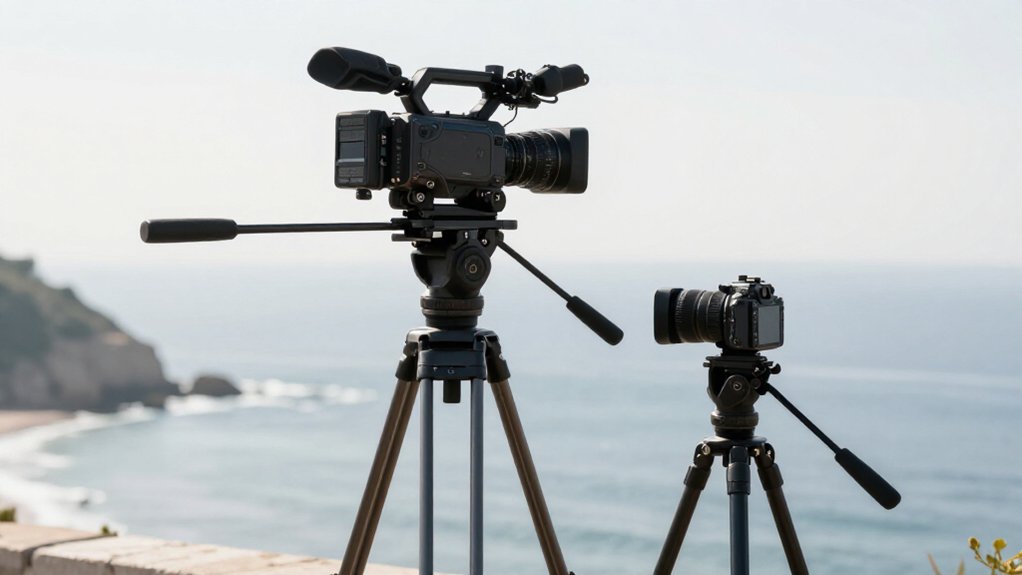
For smooth video pans, choose a fluid head: its hydraulic damping controls starts, steady movement, and stops, while separate pan and tilt drag let you tune each axis.
A ball head’s shared friction lock is faster for quick reframing, but adjustments can cause sticky motion, jitter, or tilt drift under load.
Match the head’s capacity to at least 1.5 times your rig’s weight, and balance long lenses to prevent sag.
The sections explain the trade-offs.
Pan Smoothness and Control
For smooth video pans, a fluid head’s damping cartridge applies consistent resistance, avoiding the abrupt, single-lock feel of repositioning a ball head. With separate pan and tilt controls, you can tune each axis to prevent overshoot or sudden jumps. Set pan drag so your camera settles into controlled movement, especially during slow, cinematic pans.
A ball head moves quickly, but its shared knob makes repeatable pans difficult: tiny joint adjustments can disrupt your shot. Choose a fluid head rated for at least 1.5 times your camera’s weight; flex or slippage can undermine control.
| Choice | Feel | Result |
|---|---|---|
| Fluid head | Tuned drag | Your shot feels composed and secure |
| Slow pan | Steady resistance | You hold the moment without jolts |
| Ball head | Shared lock | Small shifts can steal your framing |
| Heavy load | 1.5× headroom | Stability protects each careful movement |
Head Damping Mechanisms
A fluid head’s internal hydraulic cartridge resists movement to control pan and tilt speed, rather than letting the camera stop abruptly. This resistance lets you start, move, and finish a shot with gradual acceleration and deceleration. Set pan and tilt drag independently; match each axis to your lens weight and intended motion.
- Ease into a pan, letting drag build motion without a sharp start.
- Track steadily, maintaining a steady pace through the middle.
- Finish with a measured stop instead of snapping to a halt.
A ball head relies on friction in a ball-and-socket clamp, so its release and lock feel less damped and repeatable for video. Choose adequate capacity: an overloaded head may struggle to maintain consistent damping.
Test settings with your camera before recording.
Pan Jitter and Tilt Drift
When a pan jitters or a tilt slowly sags, inconsistent resistance is often the cause. Ball head’s single friction point may not provide consistent resistance. Torque changes from your hands or wind can make the camera micro-shift instead of settling. Tilt drift occurs when the lock can’t support your rig’s weight distribution; gravity pulls the camera down, especially with heavy rigs or long lenses.
A fluid head’s hydraulic drag provides continuous resistance, smoothing starts and stops and reducing stick-slip jitter. Separate pan and tilt controls let you tune each axis: add pan drag to counter wobble and enough tilt drag to prevent sag. If you must use a ball head, choose one rated for at least 1.5 times your total setup weight and lock it tightly; drift and jitter remain harder to eliminate than with a fluid cartridge system.
Quick Setup in the Field
When you need to reframe quickly in the field, a ball head’s single-knob loosen, reposition, and tighten workflow is usually faster than adjusting separate pan and tilt axes.
Use this sequence:
- Loosen the joint, sweep your camera toward the subject, then lock it before the action peaks.
- Reframe between takes by shifting from a wide view to a tighter composition without resetting axes.
- For a runner crossing frame, loosen, track, and tighten; prioritize a lock over perfect damping.
That speed helps when fast-moving video demands quick adjustments and smoothness matters less. A fluid head takes longer to balance and set drag, but delivers smoother controlled pans and tilts.
Choose a ball head when rapid repositioning matters most; choose fluid control for deliberate motion.
Camera Plate Compatibility
Fast reframing only works if your camera stays firmly attached, so check plate compatibility before mounting a fluid head. Most video tripods use an Arca-Swiss style quick-release clamp, so your head’s plate must share that profile. A plate that doesn’t match can’t lock securely, even when the clamp appears closed.
Next, verify the mounting screw. Your camera may use a 1/4-20 thread, while the head or plate may be configured for 3/8-16. Use the correct adapter plate for your setup; don’t force mismatched threads or assume the screw will hold.
This fit matters especially for video. Fluid damping applies resistance as you pan or tilt, and an incompatible plate can let your camera micro-slip under that load. Before buying, confirm both the Arca-style plate standard and the required thread for a firm, vibration-resistant connection.
Replacement-Part Availability
Before you buy, check whether the manufacturer can supply replacement parts for the head’s key wear components.
For fluid heads, internal dampers may need model-specific drag cartridges, pads, O-rings or damping components. Ball heads may use simpler knobs, springs or friction plates, but confirm compatibility with your exact series. Prefer a current product line with documented parts lists, service manuals or authorized repair channels; budget no-name models may leave you unable to source parts.
Before purchase, verify whether the maker sells parts directly or offers repair, and check the cost. Visualize this:
- A worn drag cartridge no longer holds a smooth, even pan.
- A damaged O-ring leaks damping fluid inside the service bay.
- A loose ball-head knob fails to lock your camera securely.
Counterbalance Range Limitations
A fluid head’s counterbalance works only within a specific range, typically matched to its rated payload. If your camera and lens exceed that range, the tilt can feel heavy and drop, producing jerky movement. If your rig falls below the minimum, it may float or rebound, making a chosen angle hard to hold. Neither fault necessarily means the head is defective; your setup may simply sit outside its adjustment limits.
Before judging motion, weigh the camera, lens, battery, and accessories, then choose a head whose counterbalance range covers that total. Aim for useful headroom—around 1.5 times your rig’s weight—rather than operating at the limit. Remember, counterbalance supports tilt, not pan. Set pan drag separately to control movement speed and maintain consistent sweeps.
Portrait Orientation Limitations
When you rotate your camera vertically, a ball head’s single knob can shift your framing, while a fluid head’s damped movement helps keep tilts controlled. The camera’s changed center of gravity can also make a ball head less stable, especially with side-mounted accessories.
For frequent portrait video, use a fluid head with reliable drag or locking on the axis you adjust most.
Vertical Framing Limits
In portrait orientation, small pan or tilt movements can make horizons and vertical lines drift noticeably, so a fluid head’s adjustable friction helps you hold a steady composition. A ball head’s single knob can shift roll or pan as you loosen it for vertical framing; after tightening, you may need to re-level carefully. That correction can interrupt a take.
- Separate pan and tilt friction lets you make fine, repeatable tilt adjustments without disturbing the rest of the frame.
- A ball head’s stiction can turn a tiny correction into a visible jump during a framing change.
- While tracking, controlled resistance helps prevent the camera from dropping or creeping after lock-up.
Check the frame, not just the head, to confirm vertical lines stay aligned through movement.
Portrait Orientation Workarounds
For portrait video, rotate the head 90° and recheck your framing, since loosening and retightening a ball head can shift the camera or disrupt its motion axis. That movement can also introduce micro-jitters during slow adjustments: a ball head’s single lock controls the ball-and-socket joint rather than pan and tilt independently.
Choose a fluid head when you need repeatable vertical motion. Its damping preserves a consistent feel after rotation, and modern models let you set pan and tilt drag separately. For tighter control, use a pan-and-tilt, three-way, or geared setup; independent axes reduce creep as you refine composition. If you switch formats often for talking-heads or social clips, quick locks and damped movement can spare repeated re-leveling between portrait and landscape takes on set.
Handling Long Telephoto Lenses
With a long telephoto, use a gimbal-style setup or balance the lens on a fluid head to keep its center of gravity supported and prevent sag when you tilt. Choose a head rated for at least 1.5 times your loaded weight, and adjust pan and tilt drag separately to control torque and start-stop jump.
This support lets you track moving subjects smoothly; verify the mount standard and lock the baseplate against shifting.
Balance Long Lenses
A gimbal head balances a long telephoto lens by placing the camera-and-lens pivot at the system’s center of gravity, making tracking smoother and more stable. With a 600mm-class setup, balance matters: when you release the controls, the rig should stay put, and your hands should guide it rather than support its weight.
- Mount the lens foot, then slide it until the pivot sits beneath the combined camera-and-lens center of gravity.
- Track a distant subject; a balanced rig follows with less effort and steadier framing.
- In breeze, pair that balance with a heavy-duty head to limit amplified vibration and sway.
On a fluid head, match pan and tilt drag to payload for clean starts; verify mount and plate fit before filming for your specific setup.
Control Lens Sag
When a heavy telephoto slowly nose-dives after you tighten a ball head, switch to a gimbal head that supports the setup at its center of gravity.
For lenses in the 300–600mm range, this support keeps the body and lens balanced; a single locking point can let the front end droop. If you must use a fluid head, choose one with counterbalance and a rated load that prevents the weight from slowly pulling the tilt down.
Weigh your camera and lens, then select a head rated for at least 1.5× your setup weight. A quick-release plate reduces flex between the lens and head. Seat the mounting screw; smaller heads use a 1/4-20 screw. Check the connection for play, since looseness can worsen sag.
Track Moving Subjects
For 400–600mm lenses, a gimbal head balances your camera around its center of gravity, making it easier to track moving subjects smoothly. For video, though, choose a fluid head with enough payload capacity and adjustable drag, so pan and tilt resistance remains consistent as you follow fast action.
- Mount your body, heaviest lens, battery grip, and monitor; total their weight, then choose a head rated for at least 1.5 times that load.
- Confirm the head’s interface matches your tripod—typically 3/8″-16 on larger heads or 1/4″-20 on smaller ones.
- Set drag to control deliberate movement, then use precise pan/tilt adjustments to make small corrections without jerky starts or stops.
This setup limits sag and helps you keep a runner or bird framed through a move.
Video Head Budget Tradeoffs
Expect to pay more for a fluid head, typically $200–$1,000, compared with $50–$300 for a ball head, because its damping system and separate pan and tilt drag controls support smoother, more predictable movement.
That premium buys a fluid cartridge that meters resistance; separate adjustments let you tune panning and tilting independently. A ball head’s single locking control clamps a ball-and-socket joint, so pans can feel sticky or jerk despite careful technique. Don’t assume the cheapest fluid head will perform well: limited drag range and neglected maintenance can undermine smoothness.
For regular video work, a reliable mid-priced model is often a safer choice than an ultra-low-cost head, whose load consistency and specifications may be less trustworthy. Before buying, weigh your complete rig, including body, heaviest lens, grip, microphone, and monitor. Choose a rated capacity at least 1.5 times that total; insufficient capacity can cause unstable, uneven movement, even when you use a fluid head correctly.
Conclusion
Choose a fluid head when you need controlled pans, adjustable damping, and reliable tilt balance; a ball head suits quick reframing, but it won’t match dedicated video control. Before buying, check counterbalance range, plate compatibility, portrait needs, and support for your longest lens.
In the field, level the tripod, lock unused axes, and test a slow pan. Spend for smoothness you can use: a stable, well-matched head protects footage more than extra features ever will.