How Much Should You Spend on a Tripod? Budget Tiers That Actually Hold Up
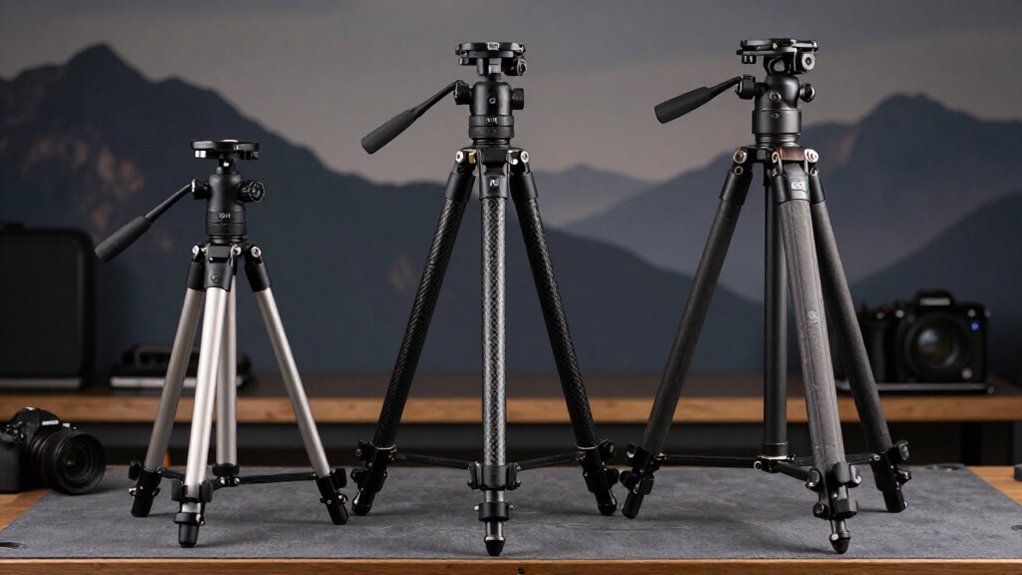
Spend according to your rigged camera’s weight, not its price: add body, lens, battery, grip, and plate, then choose legs and a head that hold everything without wobble or creep.
For occasional travel, stable aluminum may suffice; frequent hikes can justify lighter carbon fiber and faster locks.
Stills suit ball heads; video needs controlled fluid movement.
Check used locks, plate fit, returns, and repair support before paying more.
More checks can help you choose wisely before buying.
Payload Before Price
Start with the weight of your full shooting rig, not the tripod’s price: add your camera, lens, and any accessories you’ll use, then choose legs and a head that can hold that load without wobble or drift.
Treat the advertised maximum as a starting point, not proof: ratings rarely predict how a head behaves under your exact setup. Check hands-on reviews for creep resistance and stability at a comparable payload. If your rig exceeds what the head can manage, tightening the controls may not stop gradual tilt or camera drift.
A lighter setup, meanwhile, doesn’t need an expensive head built for loads you’ll never carry; excess capacity can mean wasted spending. Prioritize head quality for smooth drag and useful counterbalance, then match and balance it to your rig. For context, compact models such as the Manfrotto BeFree may list roughly 22 pounds of capacity, but that figure matters only if your camera-and-lens combination stays stable in practice at your actual payload.
Travel Frequency and Terrain
If you travel several times a year, a lighter tripod with quick-to-use locks can save effort on every outing: the 2.6-pound carbon-fiber SmallRig AP-20 sets up with flip locks and reaches about 62.2 inches, a practical fit for lighter mirrorless or Micro Four Thirds kits.
For mixed terrain, compare working and minimum height. K&F’s 64.1-inch tripod weighs about 2.53 pounds; the Feisol CT-3372 reaches 4.1 inches for low compositions.
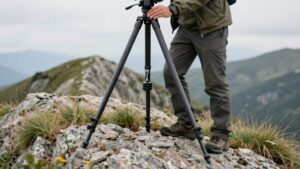
Outdoors, value stability per pound: carbon fiber helps, but leg stiffness and your head affect long-exposure sharpness. Wet coastal trips may justify Leofoto’s water-, dust-, and corrosion-resistant Poseidon Ocean LP-324C X, at 3.15 pounds.
For hiking or carry-on travel, folded length matters: Manfrotto’s BeFree closes to 16.93 inches, versus 23.2 to 24.8 inches for Feisol models.
Leg-Lock Design and Materials
Compare leg locks and materials by how they work in the field, not just by their specs: flip locks adjust faster, while twist locks usually pack more compactly.
You should test each latch with cold hands and grit: a loose lever slips, while an overtightened collar slows setup. Aluminum gives budget and midrange kits a solid stability baseline; carbon fiber cuts carry weight, but costs more and may flex in wind. Extend legs before raising the center column to keep your camera steadier.
| Choice | Field tradeoff |
|---|---|
| Flip locks | Faster setup |
| Twist locks | Compact packing |
| Aluminum | Solid baseline |
| Carbon fiber | Lighter, costlier |
| Leg extension | Steadier than column |
Compare height claims with planted-leg stability; extend the legs first, and check wind-flex reports before you buy online.
Tripod Head Type Tradeoffs
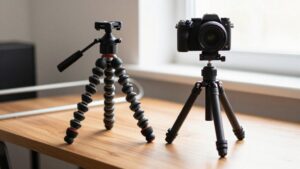
A ball head gives you compact, quick framing with one lock, while a three-way head lets you adjust pan, tilt, and roll independently for precise compositions. For video, choose a fluid head with drag and damping to keep pans and tilts smooth; a ball head’s set-and-lock motion can feel abrupt.
On budget tripods, check reviews for head drift under your actual camera load, and confirm you can swap heads if your work changes.
Ball Heads: Compact Flexibility
Because a ball head lets you loosen one control, reframe quickly, and lock the camera in place, it suits still photography better than movements that need precise, separate adjustments. It’s fast for portraits, landscapes, and quick changes between vertical and horizontal framing: loosen the main knob, aim, then tighten. Unlike heads with independently controlled axes, a ball head trades fine, staged adjustment for compactness and speed. Check its rated payload against your camera, lens, and accessories, not just the camera body.
If your rig approaches or exceeds capacity, the ball may creep after you lock it, softening a carefully composed shot.
Budget heads drift or fail; under $200, Vanguard Alta Pro 263AB includes a ball head with levels. Check large-lens reviews for fit.
Fluid Heads: Smooth Panning
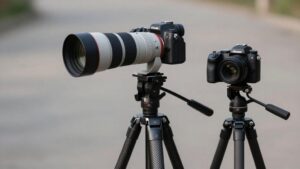
When you need sustained, smooth pans, a fluid head gives you controlled drag and, on some models, counterbalance to keep the camera from drifting as you tilt. That control matters most when you’re tracking action or making a deliberate video move. A model offers repeatable counterbalance steps, letting you match support to your camera and lens rather than fighting a nose-heavy tilt.
Set drag so the move starts without a jerk and stops without bounce; cheap heads may feel notchy or uneven as wear builds. Compared with a ball head, a fluid head is slower to reposition for quick stills framing, but much steadier for sustained pans. If motion control is your priority, upgrading from a basic pan or ball head can improve footage more than changing tripod legs.
For mixed stills and video, choose a system with a swappable head, so you can fit the right tool to each job.
Three-Way Heads: Precise Adjustments
For still subjects that need exact alignment, a three-way head trades a ball head’s speed for more precise, repeatable framing: use the pan bar and two tilt wheels to adjust each axis independently. You can level a horizon, refine a vertical, then pan without disturbing either tilt, handy for landscapes and studio-style shooting. Compared with a ball head’s single-lock repositioning, though, each correction takes another step, so you’ll work more slowly when action unfolds or you need to find and shoot quickly.
Before buying, check reviews for camera creep after you tighten the controls; a listed payload rating doesn’t guarantee a head will hold your setup. Precise adjustments won’t fix a shaky platform, either: stable legs and vibration control still matter for sharp long exposures. For video, choose a fluid head instead; wheel-by-wheel positioning won’t provide smooth, damped pans and tilts.
Match Head To Work
Choose the head for the work: a ball head lets you reframe still photos quickly, while a fluid video head uses controlled drag for smooth pans and tilts. For long exposures, a ball head must hold your framing without creep after you tighten it.
Check a head’s effective capacity against your camera-and-lens payload; if you exceed it, the setup can creep after tightening, especially during long exposures. A fluid head needs enough payload support, suitable drag, and counterbalance to keep your rig level; an undersized model may drift or feel notchy as you pan and tilt.
Don’t trust max-weight claims alone: read reviews from shooters using similar lenses and camera bodies. If you shoot both stills and video, choose legs that let you swap heads, carrying a ball head for photos and fluid head for motion when each demands it.
Secondhand Tripod Bargains
A carefully maintained used pro-style tripod can save you substantially versus retail and outlast a new budget model, but check each leg lock for smooth travel and firm clamping. Don’t trust payload ratings alone: tighten the head, test for play or drift, and confirm its model and mounting plate fit your camera.
Compare the savings with any return coverage, then test stability and adjustment range before you buy.
Check Build Quality
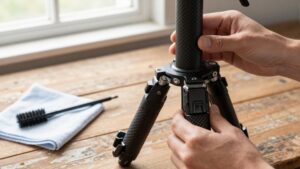
Before buying a used tripod, test its locks and head under load: flip or twist locks should clamp firmly without slipping, and the tightened head shouldn’t creep or shift. Inspect each lock through its travel: it should move smoothly, then stop decisively, without grit or spring-back.
Extend and retract every section; compare resistance across legs. Worn clamps can let a leg slide. Tighten the head and nudge the camera. A sound ball head stays put; a tired one drifts during long exposures, even if its legs seem excellent.
Check joints and the center column for corrosion or sand. Finally, mount your camera and raise the tripod from fully retracted to full height. Confirm the plate and adapter feel secure, with no looseness at the screw.
Verify Payload Capacity
When you’re weighing a secondhand tripod bargain, add up your rigged payload—camera, lens, grip, battery, and plate—and check whether the head can hold that weight without creeping, not just whether it meets the maker’s “max load” figure.
Then search reviews for drift or creep after tightening with loads like yours; budget ratings can oversell capacity by a wide margin. A head may seem steady in a quick test yet let a long exposure sag slowly.
Choose a rated capacity comfortably above your rigged weight and test the used unit by locking it at your usual shooting angle, then watching the framing for movement. A light travel tripod such as the 2.6-pound SmallRig AP-20 suits smaller mirrorless kits, but a full-frame body with telephoto glass can overwhelm its head. Feel for smooth lock action and confirm tightening holds firm; play can turn a low-cost find into unusable support for slow-shutter work, especially when framing distant, heavy subjects outdoors, too.
Inspect Head Compatibility
Check the head’s mounting interface first: an Arca-Swiss clamp accepts compatible plates, while a fixed proprietary plate may not fit your camera rig securely.
Next, compare the head’s payload rating with your complete setup—camera, largest lens, and bracket. A bargain head may hold it briefly yet let the framing creep after you tighten the ball. Treat published maximums cautiously; check independent tests before buying, especially if you change lenses often.
Confirm the included head matches the listing. A Vanguard Alta Pro 263AB commonly pairs with an SBH 100, not an SBH 250, and that difference affects capacity and stability.
Pan and tilt each axis, test locks, and feel for play, sticking, or rough movement. Those faults can make a cheap used kit unreliable.
Compare Warranty And Savings
A used tripod can save you more than a low-cost new one if its locks hold, its head moves smoothly, and the camera doesn’t drift after you tighten it. Previous-generation models can perform nearly identically to current versions, so you may pay far below retail without inheriting the frequent failures that make cheap gear costly. Warranty terms vary by brand and purchase channel; treat the discount as worthwhile only if you don’t need coverage, unless the seller or manufacturer confirms transferability.
On arrival, cycle leg locks and pan or tilt the head, checking for play, binding, and ballhead creep. If possible, buy with returns; test stability and confirm the included head model—an Alta Pro’s SBH 100 versus SBH 250 can change the deal.
Arca-Swiss Plate Standards
Because Arca-Swiss compatibility can save time across your gear, look for a head with a clamp shaped for the standard dovetail plate. An Arca-style plate typically screws onto your camera’s 1/4″-20 tripod socket, then slides into the head’s receiver. That shared interface lets you move between compatible heads and cameras without swapping mounting hardware; many $150 travel tripods, including the Manfrotto Element Traveller, include a compatible plate.
Before buying, check the clamp’s dovetail width and height, plus whether its jaws contact the plate fully. Compare that fit with a loose or rocking plate: the label alone doesn’t guarantee a secure match. Clamp your camera in, test for play, and confirm the lock holds before you trust the setup with valuable gear in actual use.
Repair Parts Availability
Once the Arca-style clamp fits securely, consider what happens if the head or leg locks wear out.
On a bargain tripod, you may find the ball-head cartridge or lock assembly unavailable separately. If the head develops play or creep, you might replace the whole head, or discard the legs too.
Even nominally repairable models can require a complete leg set or head assembly, pushing repair costs close to replacement price.
Established brands more often stock leg locks, quick-release plates, and head components through service departments or third-party parts shops. That doesn’t guarantee every screw or seal remains available.
Before buying, search the exact model number and generation, not just the brand name. Check official spare-part listings, regional service options, and whether parts ship individually.
Overlooked Tripod Load Ratings
How much weight a tripod holds in practice matters more than the headline max-load figure: manufacturers’ ratings are loose ceilings, not guarantees of stability.
Treat published capacity as a starting point, then check reviews that test real-world rigidity; a creeping camera can ruin a long exposure. Look beyond leg capacity: your head must hold the rig without slowly sliding after you tighten it.
- A lightweight budget traveler like K&F’s 64-inch model may advertise about 60-pound capacity, yet aluminum legs can feel springy.
- Feisol CT-3342 lists 55-pound capacity at about 2.5-pound weight, but its head still needs to match your load.
- At an awkward angle or in light wind, an undersized head can drift while the legs stay planted.
Compare head-and-leg capacity together before buying.
Quick Setup in Low Light
When you’re setting up in low light, prioritize a tripod that deploys quickly and stays rigid over one that reaches the greatest height. Raise the center column only when necessary: the extra reach can soften the stance and introduce shake during long exposures. Spend enough for a smooth head that locks firmly; a reliable ball head often stops creep before a pricier set of legs helps.
- Flip locks let you snap the legs open quickly, unlike slower twist collars when you’re repositioning in darkness.
- On a slope, set legs firmly and keep the camera near eye level; don’t chase the spec-sheet maximum.
- For travel, compare the 2.6-pound SmallRig AP-20 (62.2-inch max) with the 2.5-pound Manfrotto Element Traveller (52.7-inch max): choose rigidity at usable height.
Conclusion
Spend according to the loads, miles, and weather you actually face—not the biggest number on a spec sheet. If you carry a light kit on easy trails, an entry-level tripod with dependable locks may be enough.
Heavy lenses, rough terrain, or frequent low-light setups justify sturdier legs, a reliable head, and available repair parts. Before buying, check real payload capacity, plate compatibility, and used-tripod condition. A stable tripod you’ll carry and set up beats an overbuilt one left at home.