Geared Head vs Ball Head: When Precision Framing Is Worth the Weight
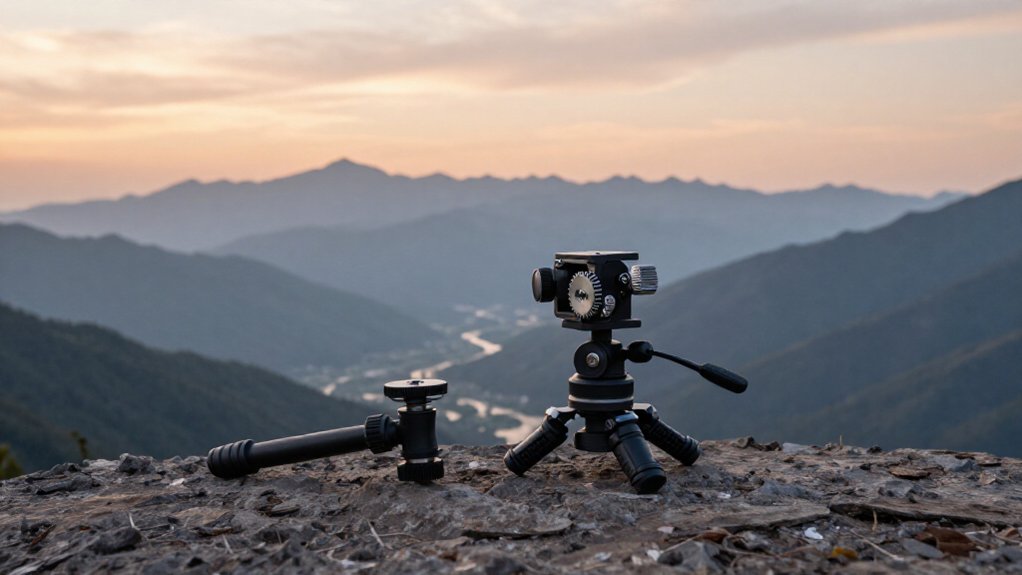
Choose a geared head when you need repeatable, precise framing, especially for architecture or panoramas. Separate pan and tilt controls let you correct one axis without shifting the other, helping keep horizons level and façade lines aligned. A ball head gets you positioned faster, but loosening and relocking can cause overshoot or sag with heavy gear.
Geared heads take longer to adjust and add weight, yet reduce correction work. The sections below explain when that trade-off pays off.
Independent Axis Adjustments
With independent axis adjustments, a geared head lets you change horizontal pan without altering vertical tilt, or vice versa. You can keep one framing axis steady while correcting the other, which limits unintended composition changes.
| Adjustment | Axis changed | Axis preserved |
|---|---|---|
| Pan | Horizontal direction | Vertical framing |
| Tilt | Vertical alignment | Horizontal framing |
| Panorama | Repeatable alignment | Level composition |
That independence matters in architecture: you can correct converging verticals or level a horizon without undoing the other alignment. Even a small tilt can skew a façade, so isolate the correction and preserve your horizontal composition. This also supports repeatable panoramas, where you maintain level and overlap across frames.
A model such as the Benro GD3WH applies the same principle, helping you make adjustments with less framing drift and maintain stable alignment.
Geared Controls and Ball Release
Geared heads use three independent controls, typically for pan, tilt, and leveling, so you can fine-tune alignment without disturbing the rest of your composition. Turn the knobs to make small corrections without loosening and re-locking a single clamp; that reduces shift and overshoot at your chosen framing.
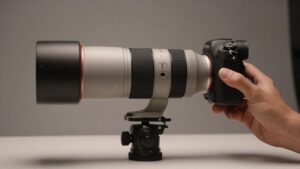
With a ball head, you release the lock, reposition the camera, then tighten it again. Friction in that lock can allow slight movement or sag, particularly with a heavy camera-and-lens setup. For architectural work, geared controls let you fine-turn until lines align precisely, while a ball head favors quick repositioning over repeatable alignment. A hybrid such as the Arca-Swiss Monoball P0+ offers limited geared adjustment, up to about 10°, alongside ball-style release for faster positioning in practice.
Preventing Horizon Drift
When a level horizon matters, a geared head’s separate pan and tilt knobs let you correct alignment without shifting the rest of the frame during re-tightening. Because the knobs twist rather than release a single ball, you can make fine corrections while preserving composition. With a ball head, friction can permit slight sag after locking, particularly under a heavy camera-and-lens load; you may need repeated lock-and-check cycles to restore level.
For architectural work, that drift can misalign verticals and horizontals, forcing time-consuming level or perspective corrections later. A geared head holds exact framing more reliably through adjustment, so small shifts are less likely to accumulate after you’ve leveled the camera.
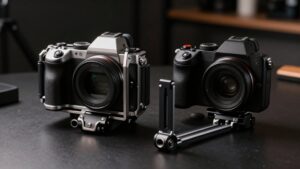
An L-bracket or cage lets you switch orientation without remounting, limiting disturbance to level.
Setup Speed in the Field
In the field, a ball head usually gets you aimed fastest: loosen one knob, reposition the camera, and lock it again. Fine framing can still take longer: you may overshoot, make another adjustment, and find that a heavier lens shifts slightly as you lock the head.
A pan-and-tilt head gives you more control without a full re-aim: adjust horizontal and vertical axes independently.
Geared heads take longer initially because you turn multiple knobs, but incremental adjustments let you lock exact framing without loosening and retightening, which can cause drift. Their repeatable axis movements help you make consistent panoramas. For architecture, this control can save time on site and during postproduction by reducing avoidable corrections to tilted verticals and horizons.
Center-Column Clearance Requirements
For precise geared-head adjustments, keep the camera’s travel path clear of the center column, tripod legs, and head stops. A geared head delivers micro-adjustment precision only when you can move each axis smoothly and repeatably. If your tripod has a center column, lower it as far as practical to improve stability and reduce tiny framing shifts that fine tuning may not fully correct.
Before shooting, mount your camera or L-bracket, then sweep through your intended pan and tilt angles. Check that the body or lens won’t strike the extended column, tripod legs, or mechanical stops. This clearance lets you align horizontals and verticals without disturbing the composition. Ball heads tolerate quick angle changes better, so clearance matters less when architectural alignment isn’t your priority.
Gear Lubrication Intervals
Clearance protects your composition during adjustment; regular gear maintenance preserves the geared head’s smooth, repeatable motion. Lubricate moving bearings and threads only at intervals your manufacturer recommends; excess lubrication can attract dust and soften fine-adjustment feel.
- At each major shooting season, inspect and clean gears and threads.
- If motion feels gritty or adjustments grow harder, lubricate; moderate use often calls for service every six to twelve months.
- Shorten that interval for frequent outdoor work or demanding weather.
- Afterward, cycle pan and tilt, then verify framing repeatability and reset knob tension if needed.
Small, separate-axis turns let you retain precise framing without overshooting; after service, confirm each axis moves smoothly and holds position through repeated incremental adjustments before you resume critical work in the field.
Gear-Tooth Contamination Risks
When dust, grit, sand, or fine metal particles enter a geared head’s teeth, the knobs can turn roughly and make your pan or tilt overshoot or drift. That rough engagement reduces the repeatability of slow, knob-driven micro-adjustments you rely on to control horizontal and vertical lines. In travel, architecture, and outdoor work, contamination risk rises when you change lenses or cameras with gloves, in wind or dust.
Keep the knobs closed when possible, and don’t wipe the teeth with abrasive cloths. Clean the mechanism regularly, keeping its teeth dry and free of residue; sticky cleaners or excess lubricant can attract particles and promote buildup or jamming. Follow manufacturer guidance to preserve engagement and locking behavior, especially on heads that adjust through gears rather than loosening a lock.
Head Weight Comparison
Gearing adds mass and bulk because separate controls support precise pan and tilt adjustments. A ball head’s single quick-lock mechanism keeps it lighter and easier to carry.
You’ll trade portability for finer framing control with a geared head.
Added Weight of Gearing
Because geared heads use separate mechanisms for pan and tilt, they’re generally bulkier and heavier than ball heads, which rely on a single friction lock. That extra mass houses gearing that lets you adjust each axis independently, reducing overshoot and post-lock shifts.
For scale, consider these points:
- NEEWER’s GM36, a travel ball head, weighs about 10.9 oz (310 g).
- TH15/TH16 geared heads use larger mechanisms for fine movement.
- TH16 adds a quick-release plate, contributing hardware beyond its gears.
- You trade added mass and slower knob turns for repeatable framing control.
When you photograph architecture or products, keeping horizons and verticals aligned can outweigh the extra weight. You turn knobs incrementally, then retain precise composition without nudging the camera while firmly locking a ball head.
Ball Head Portability Advantage
A ball head’s simpler locking mechanism makes it lighter and easier to pack than a geared head, a meaningful advantage on hikes or frequent setups. With fewer parts and less geared hardware, a ball head reduces weight and bulk. For example, NEEWER GM36 weighs about 310 g (10.9 oz), yet offers 360° panning and a 90° tilt notch for quick orientation changes.
Geared heads use separate pan, tilt, and rotation controls, adding structure and making them heavier and bulkier. You’ll notice the difference hiking or setting up repeatedly. That trade-off matters when you carry your tripod over distance or move between locations throughout the day on location. A ball head eases travel; reserve a geared head for work where precise framing warrants the extra load.
Leveling Architectural Facades
When you photograph a facade, you must align vertical lines and keep horizontal edges level to preserve its geometry. A geared head lets you correct tilt in controlled increments without shifting your horizontal framing.
A ball head moves faster, but lock-induced sag can compromise precise alignment.
Aligning Vertical Lines
For architectural facades, a geared head lets you adjust pan and tilt independently, keeping vertical lines aligned without disturbing the rest of the composition. You can preserve chosen framing as you align the facade. Ball-head tightening may introduce sag, shifting pitch and leaving edges slanted.
- Inspect facade verticals.
- Adjust pan without changing tilt.
- Turn the geared dial incrementally; stop at alignment.
- Repeat settings across exposures for consistent framing.
These separate-axis controls reduce guesswork and help you avoid overshoot, especially when small angular errors distort building geometry. A hybrid such as the Arca Swiss Monoball P0+ offers limited fine adjustment and ball-head flexibility; for strict vertical-line accuracy, choose a fully geared setup.
Consistency matters when you capture matched facade exposures in sequence.
Correcting Tilt Precisely
On architectural facades, even a few degrees of tilt can distort the intended geometry and leave verticals or horizontals visibly out of level.
A three-way geared head lets you correct each axis incrementally, so you can refine pitch and roll without releasing a single friction lock. With a ball head, loosening and retightening can shift your composition; heavier camera-and-lens loads may also sag after locking. Geared controls give you finer input and hold exact framing more consistently, especially at extreme angles.
Use an L-bracket or cage when you change orientation; it helps preserve alignment and reduces drift from re-aiming. The trade-off is weight and speed: geared heads such as the Benro GD3WH or Arca Swiss options add bulk and operate more slowly, while reducing rework.
Keeping Facades Level
Even after correcting tilt, keeping an architectural facade level demands control over each axis.
A ball head can sag or shift slightly after locking, tilting verticals or horizons and leaving you with time-consuming perspective corrections. A three-way geared head separates pan and tilt adjustments, so you can level a horizon or align a facade without disturbing horizontal framing.
This matters when facade planes and window grids demand straight lines; even a small overshoot shows clearly.
- Use separate axis controls to correct tilt without shifting your composition.
- Check verticals and horizons against the frame before each exposure.
- Choose a Benro GD3WH or Arca Swiss C1 Cube for repeatable dual-axis adjustments.
- Accept slower knob operation and greater weight and bulk than a ball head to carry.
Choosing for Architectural Facades
When architectural facades demand straight verticals and horizontals, a geared head lets you make precise adjustments across all three axes without repeatedly loosening and relocking the camera. That control helps you align the frame in-camera, minimizing small tilt errors you’d otherwise correct in post.
A ball head gets you to an angle faster, but tightening it can cause slight sag or shift, leaving the facade or horizon off by a few degrees. Choose a geared head when repeatable, exact composition matters more than speed; its knobs let you fine-tune without overshoot or relocking. For a middle ground, the Arca-Swiss Monoball P0+ Hybrid combines ball-head movement with geared adjustment over roughly ten degrees.
Add an L-bracket or cage to switch orientations while keeping your camera balanced and reducing stress on the head during final adjustments. This setup is especially useful when you need matching frames across elevations or a consistent architectural series.
Conclusion
Choose a geared head when you need repeatable, precise adjustments across independent axes, especially for architectural facades. Its controls help you hold a level horizon and align verticals without disturbing other framing decisions.
You’ll trade faster setup and lighter carry for that control, while checking center-column clearance and protecting exposed gears from grit. Choose a ball head when speed and low weight matter more than micro-adjustment. Match the head to your workflow and precision demands.