Bowl Base vs Flat Base Fluid Head: Which Leveling System Is Faster?
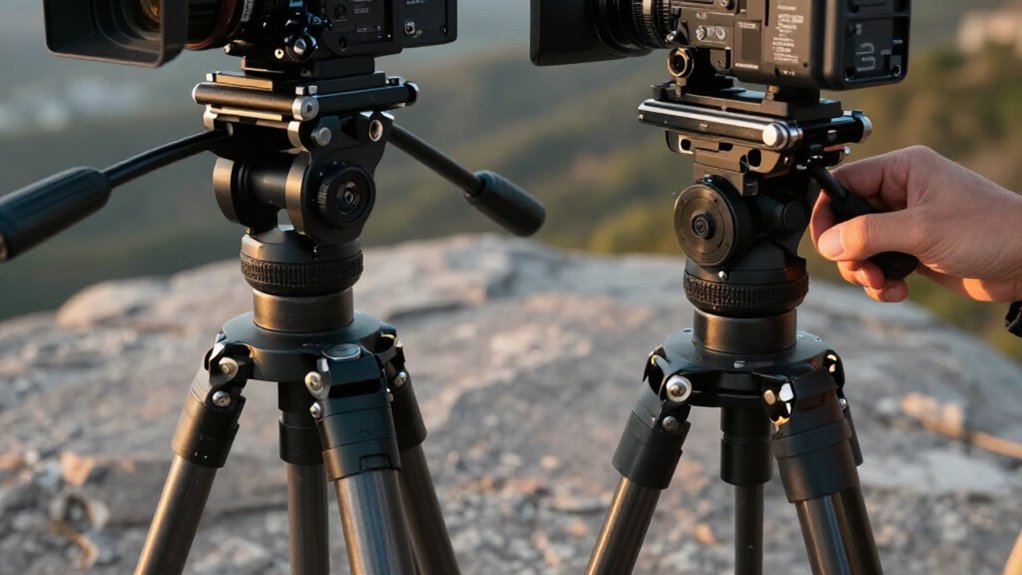
A 75mm bowl base usually levels a fluid head faster than a flat base, especially when you’re moving between uneven spots.
Loosen the clamp, let the half-ball settle, check the bubble, then lock it; a flat base often requires leg adjustments or a separate leveling adapter.
First set the tripod legs roughly level, and confirm the bubble after tightening.
Check bowl fit and center your load to prevent rocking or creep.
The details below clarify the trade-offs.
75MM Bowl Vs Flat Base Setup
If you’re comparing setup speed, a 75mm bowl usually beats a flat base: drop the head into the bowl, then shift it to level the camera without adjusting tripod legs. With a flat base, you’ll add a leveling plate or level each leg; both options take more time.
| Setup | Speed trade-off |
|---|---|
| 75mm bowl | Shift head in bowl |
| Flat base | Add leveling plate |
| Bowl option | Spirit-level plate adds reference |
| Either system | Rigidity depends on load balance |
A bowl and half-ball work without a plate, but you lose the bubble reference. For the same rig, you’ll generally save time and avoid leg adjustments. Still, bowl size and load distribution determine rigidity; balance the load over or within the bowl.
Bubble Level Alignment Steps
Once the bowl or flat-base setup is mounted, align the bubble for proper positioning before shooting: set the tripod legs roughly level, then use the head’s built-in level or a spirit-level plate as your reference. Before final alignment, ensure the adapter is seated and the head tightened evenly; an uneven clamp can distort the reading. With a 75mm half-ball, ensure any spirit-level plate sits flat on both sides.
Center the bubble with small adjustments. A bowl system lets you tilt the head at the bowl or half-ball, while a flat-base setup may require more deliberate fine-tuning at the support. Lock the mechanism, then check the bubble again: tightening can shift the head if the adapter or plate has play. This makes your final check quick and repeatable.
Uneven-Ground Leveling Accuracy
On uneven ground, a bowl-style leveling base is typically faster because one adjustment levels the camera platform without repeated tripod-leg changes. Your accuracy still depends on leg placement: if the tripod starts too far out of level, the base may reach its limited tilt range, about ±16–17° on some models, before the platform is level.
A flat base makes you correct errors through finer leg adjustments, which can take longer but may deliver greater accuracy when the head can’t tilt far enough. Also, an off-center heavy rig can increase slip risk and weaken leveling reliability with either system. For repeatable results, use the legs to remove major height differences, then make the remaining fine correction with the bowl or base before final camera alignment.
Quick Leveling on Slopes
How quickly can you level a camera on a slope? With a bowl-style head, you can loosen the clamp, let the half-bowl settle into a repeatable angle, then lock it. This usually takes fewer steps than adjusting tripod legs individually with a flat-base head. On uneven ground, a separate leveling base adds another control and can slow initial setup, though it excels at precise fine-tuning.
- Choose a bowl system when you need a fast, “level enough” horizon across changing slopes.
- With a flat base, reposition legs first; use a leveling base when precision outweighs speed.
- Check for slipping under your actual camera load: imbalance above the bowl affects stability more than published ratings.
After rough leveling, use any built-in leveling feature to refine the frame.
Bowl Adapter Fitment
Fast leveling on a slope depends on fit as much as head design: a 75mm bowl needs a fluid-head adapter sized to match, or the head may rock instead of seating flat. Before you buy, check the bowl diameter and the head’s adapter specification; “75mm” must describe the matching interface, not just the tripod. A tight, even seat lets you level and lock the head in one adjustment.
If the adapter’s loose or mismatched, rocking forces you to re-center, erasing the bowl system’s speed advantage. With a flat-base head, you’ll usually add a separate leveling adapter; it offers repeatable placement but adds an interface to check. A spirit-level plate can sharpen accuracy, though positioning it costs a step. Poor contact can encourage slip or creep, so verify fit under load.
Replacement Parts Availability
For replacement parts, standardized bowl systems usually offer more options than model-specific leveling bases. If your 75mm bowl insert or half-ball wears out, you can often source a compatible replacement from tripod-head or accessory makers. A geared flat leveling base, by contrast, may require the exact model or interface, so check parts listings before purchase.
- For a dedicated video bowl system, you can replace a failed adaptor ring or leveling plate without replacing the whole assembly.
- With a hybrid bowl and spirit-level plate, you’ll typically replace only the separately sold plate or insert.
- If you work far from service centers, choose common bowl sizes and stocked interfaces to improve repair options.
Modularity can limit downtime; proprietary bases leave you dependent on the manufacturer’s inventory.
Added Adapter Stack Height
Because a bowl-base fluid head seats directly into the leveling system, it typically adds little height; a flat-base head often needs a leveling adapter and top plate, adding several centimeters. With a bowl base, you use the head’s bowl or half-bowl interface to seat it in the leveling system, avoiding a separate plate where the system supports direct mounting.
A flat base may need a bowl adapter plus a top plate; each layer adds its own thickness. If you add a spirit-level plate between the half-ball and head, you’ll raise the head further; an integrated bubble avoids that layer. On a rig, that difference can affect pan-and-tilt clearance and force you to recheck cable or monitor space. Multiple interfaces take longer to align, partly offsetting faster leveling.
Clamp Security Under Load
Clamp pressure alone won’t secure a leveling base; you’ll get more reliable hold when you center the camera’s mass over the bowl or adapter. A bowl base resists rotation under a balanced load, while an off-center setup increases slip risk on either system.
Before tightening, confirm the mating surfaces seat fully and stay within the base’s tilt and load limits.
Clamp Pressure
Center and balance the payload before tightening, since an off-center load can make either system creep under pressure. With a bowl, the cup supports more lateral force, helping the clamp resist slip; however, gear sitting unevenly above it can turn weight into shear.
A flat base depends more on friction across the mating surfaces and the torque you apply. Check full engagement and contact; a small, misaligned interface can micro-slip under vibration even when the handle feels tight.
- Center accessories over the bowl to preserve clamp bite, not just rated capacity.
- Seat flat-base faces squarely, then tighten to the maker’s specified torque.
- Treat stated ±16–17° tilt as useful only if the clamp holds without creep.
Recheck after fitting the complete rig.
Load Stability
A bowl seat generally resists slipping better under load because its larger mating surface supports the head, but an off-center camera or lens can still shift force into the clamp and cause creep. Center your rig over the leveling interface and tighten every clamp fully; this best limits micro-slip during pans and tilts. A dedicated leveling base or flat-base adapter can feel rigid when centered, but side-loading and limited tilt range may make its clamp less consistent than a bowl seat.
Treat published capacity figures cautiously: a 33-pound rating won’t predict security if your load sits off-axis. At steeper angles, choose seat geometry that supports the load as its force vector moves. A bowl’s nest outperforms a small-contact adapter, though balance still matters.
Camera Reframing Speed
With a bowl or half-bowl head, you can reframe and level in one motion, keeping pan-and-tilt changes quick. A flat-base setup may require careful tripod-leg tweaks or a separate leveling base, slowing repeated reframes.
Match the leveling system to your shooting pace: bowl systems suit rapid repositioning, while leveling bases favor fine adjustments.
Reframe Without Releveling
When you reframe between shots, a 75mm bowl and half-ball head can get the camera level faster: loosen the head, let it settle into the bowl, then lock it. That quick reset helps you preserve a level horizon as you change composition, without turning each move into a tripod-leg exercise.
A dedicated leveling base gives you finer control, but its incremental motion can slow repeated re-leveling. A flat-base fluid head locks quickly; frequent horizon corrections may require an added level plate or base. Use the simplest leveling path for your pace.
- For fast-moving news work, the bowl’s settling action cuts pauses between shots.
- Keep your reframes simple, and you’ll spend less time correcting level.
- Choose by how often your compositions demand a fresh horizon.
Leveling Base Adjustments
For small horizon corrections, a leveling base lets you loosen the head, make a fine adjustment, often within roughly ±16–17°, and lock it again without changing tripod-leg lengths. You can correct a slight horizon error by loosening the base, dialing the head, and retightening it; you don’t need to alter leg lengths or disturb your framing more than necessary.
Bowl or half-bowl systems usually handle larger repositioning faster, since you avoid adjusting legs, but a leveling base remains efficient when only a few degrees separate your current view from level. When you repeatedly return to a consistent horizon, the base also makes that correction predictable. Check your rig’s load rating: near its limit, imbalance can make the adjustment feel less stable and slow the reset in practice.
Pan-and-Tilt Speed
How quickly can you reframe between pan-and-tilt moves? With a bowl base, you loosen the clamp, seat the half-ball, and level the head without changing tripod-leg lengths. That rigid reset helps when you need pans across subjects or locations.
A flat-base head needs a separate leveling adapter or leg adjustment. You’ll spend more time fine-tuning alignment before each shot, although a dedicated leveling base can offer corrections: often around ±16° or ±17°. Choose based on how often you reset versus how finely you need to align.
- For rapid resets, the bowl reduces time spent chasing level before panning.
- For controlled micro-adjustments, a leveling base offers finer correction.
- If you tilt aggressively, check bowl size and load balance; limited tilt range can slow consistent reframing.
Travel Kit Weight Tradeoffs
In a travel kit, a bowl system typically adds about 0.5 kg (1 lb) over a leveling-base setup, but speeds leveling at frequent stops. You might choose a dedicated leveling base such as the Sunwayfoto DYH-90i; at roughly $100, it adds about one pound while reducing leg adjustments versus leveling by changing tripod leg lengths.
A bowl-and-half-ball kit may cost less: budget roughly $60–$80 for the bowl, $20 for the half ball, and $11 for a spirit-level plate. Compare complete assemblies: weight may approach the same half-kilogram difference. A removable head stack adds height and parts; a video head can hide the bubble level, forcing rechecks. Choose the bowl for frequent fast resets, or the simpler setup when every gram matters in your pack.
Conclusion
Choose a 75 mm bowl when you need fast leveling on slopes: loosen the clamp, center the bubble, and lock the head without adjusting tripod legs. A flat base can level precisely on even ground, but you’ll rely on leg-length changes or a separate leveling platform when terrain shifts.
Check adapter fit, added height, and clamp security under load. For travel, weigh the bowl’s speed against extra kit mass; reframe quickly either way for your workflow.