Types of Tripod Heads: Every Style and What It’s Best For
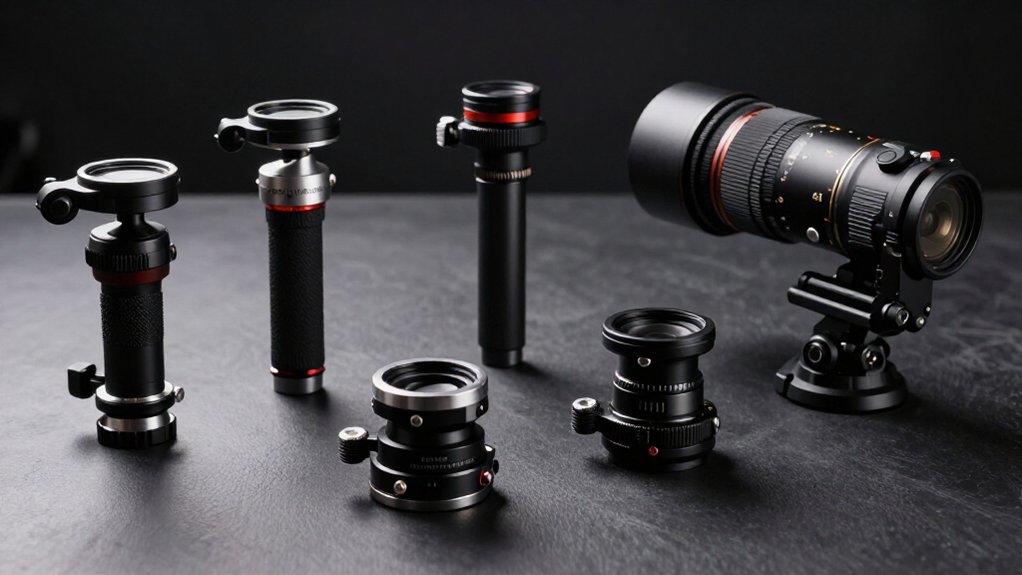
Choose a ball head when you need fast, flexible framing; choose a three-way head for precise, independent axis adjustments.
Geared heads suit controlled, fine composition, while fluid heads use adjustable drag for smooth video pans and tilts.
For long telephotos, a gimbal balances the full camera-and-lens setup near its center of gravity, easing tracking.
Match threads, plates, and load capacity before mounting.
Each design has practical tradeoffs, and the details below can help you choose confidently.
Head Movement Mechanisms
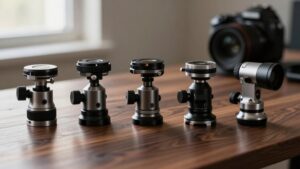
Tripod heads control camera movement through different mechanisms, each suited to a particular kind of adjustment. A ball head uses one ball-and-socket joint and locking screw, so you can set an angle, but you’ll reposition all axes together. A three-way head separates pan and tilt, letting you adjust each axis independently with levers or locks.
Choose it when framing matters more than speed. A geared head also controls pan and tilt, but gears let you make fine corrections after rough positioning. A gimbal balances your camera near its center of gravity, so the lens pivots smoothly without requiring you to support its weight.
A fluid head uses internal cartridges and adjustable drag, separately for pan and tilt, to keep moves smooth and controlled.
Plate and Mount Compatibility
Although the head-to-leg and camera-to-head connections use different standards, both must match your gear: most heads screw onto tripod legs through a 3/8-16 base thread, while cameras typically attach with a 1/4-20 screw.
Quick-release systems pair a camera plate with a head-mounted receiver, letting you slide and lock your camera on or off. Arca-Swiss compatibility requires matching the plate’s 38 mm, 45-degree dovetail rail to the clamp; similar names don’t guarantee fit.
| Interface | Standard | Check |
|---|---|---|
| Leg to head | 3/8-16 | Thread and seating |
| Camera to plate | 1/4-20 | Screw size |
| Plate to clamp | Arca-Swiss | 38 mm, 45° |
Before buying, compare interfaces with your camera and tripod. Cork or rubber at the base can resist loosening, but it won’t correct a mismatched thread.
Counterbalanced Gimbal Head Designs
A counterbalanced gimbal supports your lens around its center of gravity, letting you track smoothly with less effort than a ball head’s friction-based lock. Adjust spring tension or counterweights to match your setup, and choose a head rated for its load.
When you find the balance point, the camera should stay level with little drift; poor tuning can cause droop or rebound.
Counterbalance Mechanism
When you tilt a large telephoto, a counterbalanced gimbal uses an adjustable spring or weight to offset the camera’s load, keeping movement smooth with less effort. Unlike a simple pivot head, it helps keep a 400mm or 600mm lens from dropping or flipping as you tilt, so you can follow wildlife without constantly supporting the rig.
You first balance the camera so it stays roughly level near the center of motion; the mechanism then carries much of its weight while you guide direction and stabilize the view. You then fine-tune damping or drag to control movement speed, unlike balance, which offsets load. If balance is too light or heavy, you may see jitter or overshoot, making precise tracking harder. Keep the setup centered before tracking.
Adjustable Spring Tension
Adjustable spring tension lets you match a counterbalanced gimbal head to your lens and camera, keeping the rig near level as you pan and tilt. The setting controls how much resistance you feel: lighter tension suits slower, deliberate tracking, while firmer tension can steady faster action. Many heads let you adjust pan and tilt separately, so you can tune each axis for balanced, repeatable movement.
Before a wildlife or sports session, test the setup and refine both controls. Correct tension reduces the muscle force needed to follow motion, helping you stay stable and avoid overshooting over long periods. Too little tension lets gravity pull the camera off position; too much makes it feel heavy and jerky. Check each axis before you start field tracking.
Matching Head Capacity
After tuning spring tension, match the gimbal’s rated capacity to your heaviest complete setup: camera body, lens, battery grip, and any microphone or monitor. Add those components’ weights, then choose a head rated for at least 1.5 times the total. A typical 600mm lens often dominates wildlife-kit weight.
Treat the rating as an operational range for smooth, reliable movement, not an absolute carry limit. A head sized too closely to your payload may feel less stable and resist quick swings; excess capacity gives you useful margin. That matters when you need to reacquire a moving subject quickly. Unlike a basic support, a counterbalanced gimbal lets you swing a heavy setup with less effort while keeping motion controlled.
Finding the Balance Point
Where should a counterbalanced gimbal’s pivot sit? Align it with your camera-and-lens rig’s center of gravity, or as close as the design allows. Slide the arm fore and aft until the lens stays put when you release the tilt lock; then adjust left and right if your head offers an axis.
This setup brings torque near zero, so a heavy 400–600mm lens feels weightless compared with a rig on a ball head. Use marked increments or a calibration scale to repeat the balance after changing lenses, adding a grip, battery, or accessory. Unlike a friction-based head, a gimbal depends on balance to support the rig. That makes it practical for wildlife and sports, where you’ll need stable, responsive tracking without holding the lens in position.
Smooth Motion Control
When you track a moving subject, a counterbalanced gimbal lets you pan and tilt smoothly without the lens dropping or jerking.
Unlike a ball head, which relies on a locked ball joint to hold position, a gimbal pivots around or near your camera’s center of gravity. This geometry keeps a long, heavy telephoto setup closer to weight-neutral as you move it, so you need less force to change direction.
With 400mm- or 600mm-class lenses, that support makes fast pans and tilts easier to control than with a general-purpose head.
Before shooting, slide the camera along the mounting plate and fine-tune tension until it balances. Then tighten the adjustments. The head should respond predictably, allowing you to repeat smooth movements without fighting the lens’s weight.
Stable Wildlife Tracking
For steady wildlife tracking, a counterbalanced gimbal keeps a heavy telephoto near its center of gravity, so it feels nearly weightless as you pan and tilt.
Rather than locking a ball joint, it lets your camera swing smoothly across axes. That controlled movement helps you follow fast-moving birds without sudden jerks. Before shooting, adjust the lens-camera setup until it balances neutrally.
Correct counterbalance keeps the rig steady at angles, resisting droop and snap-back.
For long-lens wildlife work, a gimbal carries large loads reliably than a ball head. A ball head may suit quick repositioning, but it can demand more effort and provide less fluid tracking with a heavy lens. Compare designs for robust counterbalance axes and smooth bearings; these improve control during field sessions.
Handling Long Telephoto Lenses
With a 600mm lens, balance the camera at its center of gravity by sliding the lens collar until the setup stays put; this reduces fatigue and steadies tracking. A gimbal head lets you swing the lens smoothly, while a ball head can feel less stable under heavy loads, so secure the collar and choose capacity at least 1.5 times your heaviest setup.
You can then track moving subjects without holding up the lens’s full weight.
Balance Heavy Lenses
A gimbal head balances a long telephoto lens, such as a 400mm, 600mm, around the rig’s center of gravity, making it feel nearly weightless as you track a subject. Once you place the lens’s center of gravity over the head’s pivot, the rig swings in a controlled arc without making you fight its mass.
Unlike a ball head, a gimbal stays smooth and stable as you pan or tilt a heavy telephoto. You can make small corrections without the lens’s weight shifting the framing or forcing abrupt movement. For wildlife or sports, its precise directional control helps you follow fast motion and maintain consistent framing.
That control is useful when subjects change direction suddenly. Keep adjustments deliberate and smooth. Check load rating and balance before shooting.
Use Gimbal Support
When you mount a 400–600mm telephoto, use a gimbal head to balance its front-heavy weight and make aiming easier. The head pivots near your camera-and-lens center of gravity, so you can pan and tilt while it bears far less of the setup’s weight. Balance the lens; movement then feels smoother and more controlled than with many ball heads, which can turn sluggish or drift under the torque of a lens.
For wildlife and sports, that fluid motion helps you follow subjects and reacquire them without fighting the rig. Check the gimbal’s rated capacity against your heaviest camera-and-lens combination, not just the lens alone. Aim for 1.5 times that load rating as headroom, so the support can move reliably rather than operating near its limit.
Secure Lens Collars
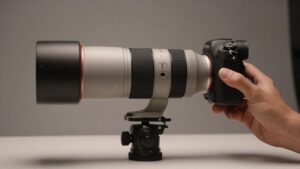
For 300-600mm telephotos, mount the lens by its collar rather than the camera body to reduce twisting and keep the head stable. Many telephoto lenses accept an Arca-Swiss-style collar, so you can clamp the lens directly, not the camera. This balances the load and reduces droop when you reposition.
Tighten the collar lock; otherwise, the lens can rotate, undermining stability on gimbal or fluid heads. For long lenses, center the collar over the gimbal’s pivot to steady adjustments. Before mounting, match the collar and plate to your head’s system: check 1/4-20 or 3/8-16 screws and compatible clamp width. A mismatched interface can shift under heavy loads, while a secure fit keeps the assembly planted. This support can also protect your camera mount under load.
Track Moving Subjects
To track fast-moving subjects with a 400-600mm lens, use a gimbal head balanced at the kit’s center of gravity, so it swings with minimal effort. This design supports heavy, front-loaded setups and lets you pan and tilt independently as you follow wildlife or sports.
The smooth control feel helps you hold steady framing through abrupt direction changes; keep your grip light and guide the lens rather than fighting its weight.
Matching Heads to Shooting Situations
Match the tripod head to the movement your shot demands: a ball head’s single locking knob makes quick still-photo recomposition fast, while a three-way head gives you precise, independent axis control for architecture and studio framing.
Choose the ball head when you’ll re-aim and lock any angle quickly. For video, use a fluid head: its fluid cartridges provide resistance-based pans and tilts, with separate drag controls to prevent jerky starts and stops.
When you frame buildings or studio subjects, independent three-way adjustments keep changes on one axis from disturbing another. For wildlife or sports with a telephoto around 600mm, a gimbal balances the lens at its center of gravity, making the rig feel weightless and tracking smoother. Choose for movement, not habit.
Quick-Release Clamp Care
Before each shoot, wipe the Arca-Swiss-style 38 mm receiver and the plate’s 45° rails with a dry microfiber cloth; grit can prevent smooth, secure locking.
Rubber or cork friction pads add grip, but they can flatten or wear. Inspect them and replace worn pads before the plate creeps. Tighten the clamping screw firmly, not excessively: too little tension can permit micro-movement, while too much can deform the rail.
After removal, keep the plate in a dust-free case or bag; sand in the groove, taper, or receiver can spoil the click and weaken retention. Each session, confirm the plate sits fully in the receiver, lock the clamp, then gently lift it with moderate force. If it shifts or releases, reseat it and check the clamp before shooting.
Load Ratings Can Mislead
Even with a clean, securely locked plate, a head’s published capacity can mislead: ratings often mark where smooth operation starts to degrade, not a safe maximum.
Treat the figure as a reliability point, not permission to load up to the limit; manufacturers may use different test methods, so two heads with identical ratings can behave differently.
For dependable control, choose a head rated for at least 1.5 times your heaviest working setup. Add the camera body, heaviest lens, battery grip, microphone, monitor, and any other attached accessories, not just the camera or lens.
A head may technically support the weight yet feel less precise than a stronger model, with locks more prone to slipping and movement more likely to drift during a tilt or pan. Compare capacity alongside control, not in isolation, and leave headroom for smooth adjustments. This matters especially when framing with long, front-heavy lenses or repositioning often.
Cold-Weather Control Tips
Cold temperatures thicken head lubricants, so work the knobs and pan/tilt handles through several movements before shooting to restore smoother control.
In freezing conditions, compare controls by head type: fluid heads need drag adjustment, while ball and geared heads can bind unpredictably. Use nitrile gloves or liners to preserve grip as you adjust without shifting three-way axes.
- Turn knobs and handles repeatedly; this warms lubricant and reveals stiffness before framing.
- Set fluid-head drag with gloves; avoid sudden tightening that can trigger sticking, then jumping.
- Clear snow and ice from quick-release locks; a nearby hand warmer can help clamps seat.
- Let the head acclimate indoors after use; condensation can freeze, thaw, and add friction.
Check each axis before packing; don’t force resistant head controls.
Conclusion
Choose a tripod head by matching its movement, mounting system, and real-world load capacity to your camera and shooting style. A ball head keeps travel light; a geared head gives you precise framing; a gimbal balances long lenses for smooth tracking.
Check plate compatibility before you buy, and test controls with gloves if you shoot in cold weather. Clean clamps regularly, and don’t trust load ratings alone; your setup should feel stable, accessible, and controlled.
Video Tripod Payload & Bowl Matcher
Add up your camera rig's weight, compare it with your tripod's rated payload at a safety margin, and check that bowl and head base match.