How to Choose an Arca-Swiss Plate That Fits Your Camera Body and Lens
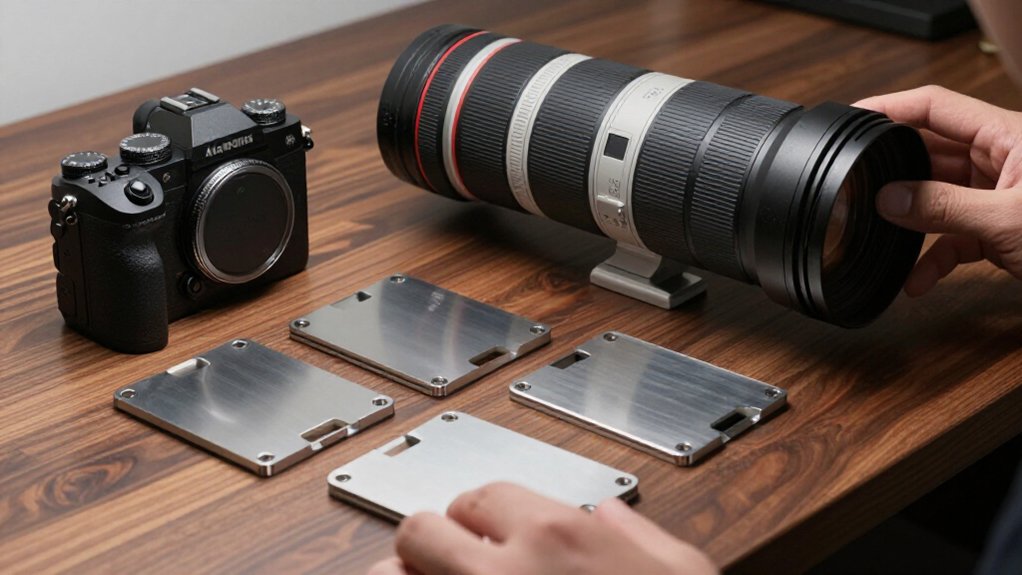
Start with your camera model and variant, then choose a body-specific Arca-Swiss plate when available.
Check screw position, battery-door and port clearance, and lens-foot contact so the plate seats without rocking.
Match the dovetail to your clamp and test engagement under your heaviest lens; longer plates and anti-twist ridges help control leverage from extended telephotos.
For frequent portraits, choose a fitted L-bracket; otherwise, a base plate may suit you.
The following checks clarify compatibility.
Camera-and-Lens Fit Summary
Start with your exact camera model and variant, then choose a camera-specific Arca-Swiss plate when available: the dovetail interface may be standardized, but mounting cutouts and battery-door and port clearances vary. Check battery-door and port access first; screw placement or plate edges can obstruct a Z9-style door. Dry-fit the plate in your clamp and confirm seating without rocking.
For a large gripped body or significant lens overhang, prioritize anti-twist features and clamp engagement. If you shoot vertical often, consider a camera-specific L-bracket: it keeps the head upright, avoiding a sideways, less stable setup with a large body. Tighten the plate screw to about 0.7–0.9 N·m, then recheck for wobble or twist. Poor seating and tolerance mismatches can undermine fit despite an Arca-Swiss label.
Check Camera-and-Lens Dimensions
Measure how far your heaviest lens extends beyond the camera’s mounting surface; at roughly 15 cm or more, prioritize anti-rotation ridges to limit twisting in the clamp. Confirm your camera’s mounting geometry: the screw position and plate profile must match the body without obstructing battery-door access or other ports.
Dovetail dimensions matter: target 36.0 ± 0.1 mm width and a 38–40° angle; widths from 35.8 to 36.3 mm may still permit lateral play or compromise retention. Check any protruding lens foot or adapter for contact that could prevent full plate seating; a longer Arca-style plate may suit some feet, but it must seat completely into the clamp. With your heaviest lens, slide the plate into the clamp; confirm it seats fully without rocking or binding.
Plate Width and Clamping Length
Although Arca-style plates commonly use a 38 mm-class dovetail, check your clamp’s standard: ARCA-SWISS monoball®Fix uses a separate 26 mm profile and won’t fit other Arca-style releases.
Match dovetail width carefully: target about 36.0 ± 0.1 mm; budget plates measuring 35.8 to 36.3 mm may seat yet still wobble.
| Choice | Check |
|---|---|
| Short contact | May allow lateral play under torque |
| Longer plate | Adds engagement for heavy, extended lenses |
If your lens projects roughly 15 cm or more beyond the mount, favor greater clamping length and anti-rotation features.
Before buying, slide the plate fully into your clamp. Confirm it seats without rocking or binding; excessive force signals a fit problem. Check that it seats securely.
L-Brackets vs. Base Plates
If you shoot mostly landscapes, a base plate keeps your head upright; for frequent portraits, an L-bracket lets you rotate the camera without tilting the head. Check the bracket’s fit against your camera body, screen articulation, and battery-door access, and confirm its dovetail seats securely in your clamp.
With heavy or long lenses, verify lens clearance and anti-twist support to maintain balance and a level horizon.
Portrait Orientation Support
For portrait orientation, an L-bracket lets you rotate the camera while keeping the tripod head upright, avoiding the less stable setup of flipping the head sideways and hanging the camera off it.
Choose a camera-specific design when available; it can preserve screen and control access while positioning the camera-and-lens center of gravity better than a base plate tilted sideways or remounted. Check whether its vertical rail limits screen articulation. On the Nikon Z9, leftward screen tilt is limited, so interference is typically minor, though the screen edge may protrude slightly.
For flexibility, choose a design with a removable vertical section that functions as a base plate. If you shoot landscape, a base plate may suffice, but side-hanging can be less stable on large-grip bodies.
Camera Body Fit
Beyond portrait handling, body fit determines whether an Arca-Swiss plate works with your camera’s doors, ports, and controls. Choose a camera-specific plate over a generic strip when cutouts must preserve battery-door and port access; dovetail fit alone doesn’t guarantee access.
If you often shoot verticals, an L-bracket keeps the tripod head upright and lets you rotate the camera into portrait orientation without turning it sideways. With a standard base plate, portrait use may require rotating the head, leaving a large gripped body hanging off the side in a less stable position.
On the Nikon Z9, an L-bracket typically won’t hinder screen movement; its display doesn’t tilt left. Choose a design with a removable vertical section, so you can use its bottom as a standalone base plate when needed.
Lens Clearance
When a long or heavy lens shifts the camera’s center of gravity, an L-bracket can keep the mounting interface predictably aligned and help resist twisting. For a lens that extends well beyond the body, this predictable alignment matters because the lens’s center of gravity can pull against the clamp.
An L-bracket is often a better match than a base plate when you need to preserve a consistent interface without changing clamp or grip orientation. If you’re choosing a base plate for landscape work, check screw and foot placement against the lens and battery door; some plates can obstruct access.
With an L-bracket, verify screen articulation and edge clearance on your body. On the Nikon Z9, the screen shouldn’t tilt left far enough to conflict, but its edge may protrude slightly. Ensure no bracket section contacts the lens or blocks access. Good fit depends on your body and lens combination.
Mounting Trade-Offs
If you often shoot vertically, an L-bracket lets you rotate the camera without flipping the tripod head and cantilevering a large, gripped body off to the side, a less stable setup. Choose one sized for your body, and check that its vertical rail won’t obstruct screen movement or controls. On the Z9, the screen doesn’t tilt left, so left-side interference isn’t a practical concern.
If battery-door access matters more, choose a base plate or an L-bracket that clears the compartment. Even slight placement differences can block the Z9’s battery door. Many camera-specific L-brackets have removable vertical sections, giving you a base plate without carrying a second plate.
If you skip the L-bracket, prioritize a wide contact surface, snug Arca fit, and anti-twist features to secure a larger body.
Telephoto Lens Support
For a heavy telephoto, support the lens collar with a compatible, sufficiently long foot, then balance the setup on your gimbal.
Check that your clamp’s grooves engage the plate’s anti-rotation ridges, especially if the lens extends about 15 cm or more beyond your camera body.
Test-fit for a snug, rock-free dovetail fit before tightening the mounting screws to 0.7–0.9 N·m.
Support at the Lens Collar
At the lens collar, an Arca-compatible foot supports a telephoto closer to its center of mass, reducing droop and strain compared with mounting only the camera body. Clamp your tripod head at the collar’s Arca-style interface, where the load path shortens and the camera-lens assembly balances more predictably during framing.
If your lens foot lacks a built-in Arca profile, a longer plate can attach at the foot area; check that it won’t obstruct zooming or collar rotation. For extended lenses, especially those projecting about 15 cm or more beyond the camera, anti-twist support helps resist torque and unwanted movement.
Keep the support firmly secured while composing, and confirm the clamp engages the foot or plate fully before tilting the setup with your lens mounted.
Choose a Compatible Foot
When a telephoto lens lacks an Arca-style foot, fit a replacement foot made for that exact lens model; it’s often more secure and convenient than adding a plate.
Check the manufacturer’s compatibility list: dimensions and screw locations must match your lens. Some feet fit several lenses, so you can plan one shared purchase for compatible Nikon 300mm, 400mm, and 500mm super-telephotos. Still, if you use multiple lenses, dedicated feet help you avoid loose hardware and field swaps.
Common pairings include Wimberley AP-620 for Sony FE 200 600mm, AP-500 for Nikon AF-S 500mm f/5.6E PF, and AP-616 for Sony FE 600mm f/4 GM OSS. Confirm the foot’s dovetail matches your clamp, typically the Arca-Swiss 38 40° profile, for a fully seated, snug fit without rocking.
Balance on the Gimbal
On a gimbal, choose a camera-specific plate or L-bracket that keeps the lens’s center of gravity in a consistent position during quick changes. A generic strip may place the assembly differently after a swap, changing its fore-aft balance and requiring fresh tuning.
If your telephoto lens extends roughly 15 cm or more beyond the mount, its leverage makes consistent positioning especially important: even a small shift can upset the gimbal’s balance. When you plan to shoot vertical frames, use an L-bracket and keep the gimbal upright; hanging a large, gripped camera sideways from the clamp can make balancing less stable.
After mounting, rebalance whenever you change plate type or lens foot, or noticeably alter the camera’s height or offset. Match the plate’s geometry to your camera and support setup, then verify that the lens-camera assembly remains balanced across the full intended range of motion.
Check Anti-Twist Security
If a heavy telephoto lens extends about 15 cm (6 inches) or more beyond the camera body, choose a plate with ridges that sit flush against the camera bottom and engage the clamp’s matching groove to resist torque.
Anti-rotation matters most when you use your lens at this overhang or switch between landscape and portrait orientation on a tripod. Before buying, verify that your clamp has geometry for the ridges; older Arca clamps may lack grooves, so the ridges can’t engage and won’t transfer anti-twist support. Check dovetail fit: many budget plates measure 35.8–36.3 mm, while the target is 36.0 ± 0.1 mm. Lateral play can amplify twisting with a lens. Avoid cork layers between clamp and camera, because this compliant interface can contribute to twist under load.
Body Clearance and Port Access
A plate’s bottom profile and screw placement must leave your camera’s battery door and ports clear, especially on bodies such as the Nikon Z9. Choose camera-specific plates or proven models with cutouts and access panels; generic strips can cover ports or obstruct hardware. Before tightening the clamp, slide the plate fully into place and check for binding.
With it installed, open the battery door completely and confirm you can reach each port without removing the plate. For an L-bracket, inspect whether its vertical section limits access or screen articulation. On a Nikon Z9, the screen doesn’t tilt left, reducing that particular interference risk.
Prefer a plate that sits flush against the body; extra bulk or spacers can create clearance conflicts and compromise access overall.
Replacement-Part Availability
For easier long-term replacement, choose a camera-specific plate matched to your body’s mounting shape and screw positions, and confirm replacement or add-on plates are sold separately for the system you’re buying.
Check that any replacement Arca-style lens foot fits your exact lens model before committing; mounting geometry and fastener placement can vary. For interchangeable feet on compatible super-telephotos, verify the shared parts list and confirm you can swap them with supplied screws without leaving hardware behind in the field.
For an established system, check whether its manufacturer sells replacement or add-on plates separately, so you can replace or expand components later. Check listings for compatible BASE70PD and QR-CINE-V/-S replacement plates online. Prefer designs that allow routine adjustments without bonded interfaces, keeping replacements straightforward.
Clamp Compatibility Issues
After checking replacement availability, confirm that your tripod or head clamp accepts the plate’s specific Arca-style dovetail geometry.
- Most “Classic” plates use a 38–40° dovetail about 38 mm wide; verify your clamp, especially if it uses a narrower 26 mm monoball®Fix profile.
- Slide the plate into the clamp and check full seating: it shouldn’t rock, bind, or show lateral play from small width tolerances.
- Match anti-rotation ridges to clamp grooves; without engagement, the design may not resist twisting under torque.
- Check channel support and retention for longer plates, such as 38 × 60 mm QR7/QD7 types.
- For portrait framing, confirm your setup keeps the camera supported; a body hanging sideways can wobble.
Test the complete pairing before carrying expensive camera gear into the field.
Mounting Screw Specifications
Before fastening the plate, verify that its camera screw is the standard 1/4-20 size specified by ISO 1222:2010 and suits the camera’s mounting interface.
Aim for at least about 5 mm of thread engagement to protect shallow socket threads during repeated tightening. Use the correct screw length for your body; excessive length can reach internal components.
Check these details:
- Confirm the plate’s screw aligns with your camera’s threaded socket.
- Keep engagement near or above 5 mm for a durable hold.
- Torque to about 0.7–0.9 N·m; don’t rely on hand-tightening.
- Inspect screw holes after 12+ months of heavy use for micro-fractures.
- Check model-specific plates for exposed or protruding screw heads that could obstruct battery doors, ports, or grip comfort.
If a screw head sits proud, confirm clearance with battery door open and cables connected; poor fit can limit access, alter handling, or prevent plate from seating flat against body.
Conclusion
Before you buy an Arca-Swiss plate, confirm its dimensions against your camera body and lens setup. Check clamping length, width, and body clearance; verify an L-bracket leaves ports and battery doors accessible.
For telephoto lenses, choose a plate that supports the lens foot or accepts a compatible lens collar. Confirm your clamp matches the dovetail profile, and check screw thread, length, and position. You’ll also want replacement parts readily available before committing to that model.