How to Choose a Tripod for Your Camera: Height, Payload, Weight and Budget
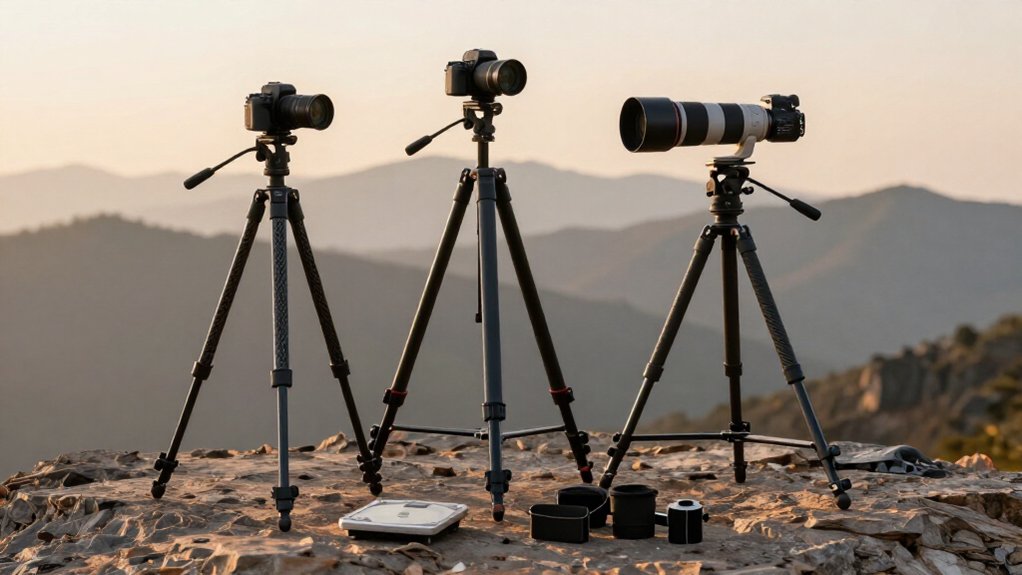
Choose a tripod by setting its working height and payload before comparing weight and price.
Leave the center column low for firmer support, and match capacity to at least twice your heaviest camera, lens, and accessories, including the head if needed.
Carbon fiber saves carry weight and damps vibration, while aluminum often costs less.
Check locks, feet, head and plate fit, replacement parts, and warranty.
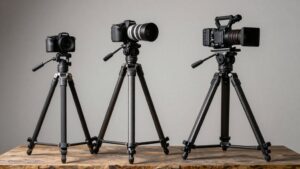
The right trade-offs become clearer when you compare complete setups side by side.
Leg Locks and Feet
Leg locks and feet affect both setup reliability and image sharpness. Twist locks offer stronger retention than flip or lever locks, which may loosen over time and collect sand or dust. If you’re choosing lever locks for faster setup, tighten each clamp; a loose leg section can transmit vibration and soften detail.
Whatever mechanism you choose, check that every section engages securely before shooting. Well-locked legs limit movement that can reduce sharpness during long exposures.
Rubber feet protect indoor floors and help damp vibration. For windy outdoor work on soil, interchangeable spike tips can provide a firmer footing. Retract or remove the spikes before setting the tripod on hardwood to avoid scratches. This lets you adapt contact points to the surface.
Camera Height and Payload
Choose a tripod whose minimum height suits your shooting position and whose maximum height lets you frame without overextending the center column. For ground-level compositions, check the minimum: the SIRUI Traveler 5C reaches 6.3 inches (0.16 m). Confirm specifications for models such as the Vanguard VEO 3+ 263CB, since minimum height varies. At working height, frame with leg extension rather than extra elevation.
Estimate payload from your heaviest body, lens, and accessories; choose capacity at least twice that total. Include the ball head if the rating excludes it or you’ll add one separately. The Traveler 5C’s 3.99 kg (8.8 lb) rating contrasts with the VEO 3+ 263CB’s 15 kg (33 lb).
Choose more capacity for heavy gear or windy conditions to protect stability and sharpness.
Center Column Design
Although a center column can add height quickly, extending it fully makes a tripod less firm than raising its three legs.
| Design | Benefit | Check |
|---|---|---|
| Removable column | Improves steadiness; enables low placement | — |
| Reversible column | Supports close-to-ground views without spreading legs | — |
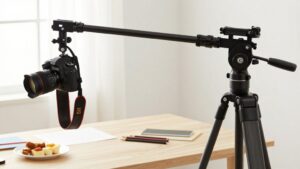
| Lateral or pivoting column | Reaches obstacles | Minimum height |
Choose a column design around how you’ll frame subjects, not just maximum height. Treat the column as a short-term height adjustment; when you need a platform, lower it and raise the legs instead.
A removable column helps when you need ground-level placement or added stability. A reversible column can put your camera beneath the tripod for close views without forcing the legs outward.
Lateral or pivoting mechanisms let you position the camera while the legs remain planted. If you rely on an angled extension, verify the tripod’s minimum height: its extra reach doesn’t ensure low positioning.
Carbon Fiber vs. Aluminum
When choosing between carbon fiber and aluminum, you’ll weigh portability against cost: carbon fiber is lighter and typically more expensive, while aluminum is heavier and usually cheaper.
Carbon fiber also transmits less vibration, which can help you capture sharper images, while aluminum may require more care to limit movement. Match the material to your budget, carrying needs, and stability requirements.
Weight and Portability
If you carry a tripod often, carbon fiber usually offers a better balance of portability and stability: it weighs less than a comparable aluminum model and transmits less vibration, which can help preserve sharpness during slow exposures. Your choice should also reflect how far you travel and what you can pack.
A compact carbon-fiber model such as the SIRUI Traveler 5C weighs 1.9 lb (0.86 kg), folds small, and reaches 54.3 in, while supporting about 3.99 kg (8.8 lb). The Vanguard VEO 3+ 263CB weighs 5.91 lb (2.68 kg), so check packed dimensions before assuming it’ll fit your camera bag.
Aluminum can cost less, but weight varies: the Amazon Basics 50-inch tripod weighs 1.23 lb (0.56 kg). Compare weight, packed length, load rating, and price together.
Strength and Stability
Beyond packed weight, stability depends on how a tripod handles vibration and supports your camera at full extension. Carbon fiber generally weighs less and damps vibration better than aluminum in the same class, helping you preserve sharpness at slow shutter speeds. Aluminum frames usually weigh more and transmit more vibration, so you may see blur when the camera or lens moves during exposure. At extension, assess leg diameter, locks, center-column use, head rigidity, and payload; a stated maximum load alone doesn’t guarantee stable support.
Carbon fiber resists weather and corrosion better and conducts less electricity, aiding outdoor durability. The SIRUI Traveler 5C weighs 0.86 kg and holds 3.99 kg; the 0.56 kg Amazon Basics aluminum model holds 2 kg. Check extended stability against your payload.
Cost and Value
Carbon fiber tripods cost more up front, but you’re paying for lower weight and better vibration damping, which can help keep images sharp during slow exposures.
Compare figures: Vanguard VEO 3+ carbon-fiber model costs $400, weighs 2.68 kg (5.91 lb), and supports 15 kg (33 lb). The $19 Amazon Basics aluminum/plastic model carries 2 kg (4.4 lb), so its low price comes with a lower rating.
For portability, SIRUI Traveler 5C costs $110, weighs 0.86 kg (1.9 lb), and supports 3.99 kg (8.8 lb), offering value per weight. Yet its center column can flex, and stability is so-so, reminding you that material alone doesn’t determine performance. Carbon fiber resists weather better, while aluminum costs less for support weight but may transmit more vibration.
Choosing the Right Material
Price is only one part of choosing a tripod; material affects weight, vibration control, and durability. Carbon fiber legs typically weigh less and transmit less vibration than aluminum, helping you preserve sharpness during low-light or slow-shutter exposures. For location work, carbon fiber’s greater resistance to weather impacts can support long-term use.
The Vanguard VEO 3+ 263CB weighs 2.68 kg (5.91 lb), while the SIRUI Traveler 5C weighs 0.86 kg (1.9 lb), illustrating the range of carbon-fiber designs. These benefits usually come at a higher price: the Vanguard costs about $400 and the SIRUI about $110. Aluminum generally costs less and offers strong support for its weight, though it may vibrate more. The aluminum Manfrotto BeFree Advanced GT XPro weighs about 2 kg (4.41 lb). Balance stability, carry weight, conditions, and budget.
Tripod Head Type
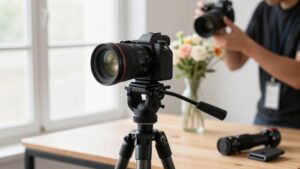
Your head choice affects how quickly and precisely you can frame a shot: ball heads reposition quickly with one main knob, while pan-and-tilt heads provide separate controls for each axis.
Gimbal heads support balanced movement with long or heavy lenses, so match the head to your camera setup and shooting style. Check compatibility, usable height, and tripod stability too, since a capable head can’t prevent vibration from a flexing or undersized tripod.
Ball Heads
A ball head uses a single locking control to loosen, aim, and secure the camera, making repositioning fast but less precise than adjusting separate axes. It suits you when speed matters: one control releases the camera for framing changes and locks it in place. This design helps you reposition quickly at low or awkward angles without extending the tripod unnecessarily.
For precise composition, consider extra controls or practice micro-adjustments; small movements can shift multiple directions at once. Check payload and rigidity with your camera and lens: the Vanguard VEO 3+ 263CB 160S supports 15 kg (33 lbs), while the SIRUI Traveler 5C is rated at 3.99 kg (8.8 lbs). A long center column can increase stability concerns, so carefully assess your setup at full extension.
Pan-and-Tilt Heads
If a ball head’s speed makes precise framing difficult, a pan-and-tilt head gives you separate controls for horizontal pan, vertical tilt, and usually a third axis or lock. These controls let you adjust one direction without shifting the others, so you can build repeatable compositions with deliberate movements. Unlike a ballhead, which releases and moves several axes together, a three-way head supports careful framing for landscapes and architecture.
They’re also especially useful when you need to make a small correction after tightening, without re-aiming the whole camera setup. For example, budget Amazon Basics 50-Inch tripods include a three-way head rather than a ball head, giving you finer control at modest cost. Choose this design when accuracy and measured adjustments matter more than rapid reframing.
Gimbal Heads
When you use a heavy telephoto lens for wildlife or sports, a gimbal head lets you pan and tilt smoothly while keeping the camera balanced, preventing it from flopping as its angle changes.
Unlike a ball head often bundled with lightweight tripods, a gimbal supports a front-heavy lens without careful counterweighting. When selecting tripod legs, account for the head’s weight as well as your camera and lens; don’t rely on the stated maximum payload alone.
Vibration control also depends on the rigidity of the complete system. Gimbals benefit from sturdier legs because higher effective loads and heavier movement can expose flex. Check that leg locks stay secure through repeated adjustments; twist locks can offer greater durability than flip locks. This helps you maintain steady, low-effort control.
Match Head to Use
For rapid framing, you’ll usually find a ball head easiest to reposition, as on the Vanguard VEO 3+ 263CB and VEO 3GO 235CB. Choose a three-way head when you need independent pan and tilt adjustments; that separation gives you control for precise landscape or architectural compositions compared with a single-action ball movement.
For quick angle changes, prioritize accessible knobs and buttons. The VEO 3+ 263CB adds intuitive controls and a level indicator, helping you recheck framing.
Verify that the head’s plate matches your camera’s mounting system. Arca-type and proprietary plates aren’t automatically interchangeable; a lock matters more than head features. The Peak Design Travel Tripod uses a PD, Arca-type plate.
Match head capacity and tripod rigidity to your setup. A carbon tripod with a ball head needs support; the VEO 3+ 263CB combo is rated to 15 kg, while the Amazon Basics 50-inch supports 2 kg.
Mounting Plate Compatibility
Mounting-plate compatibility determines whether your camera can attach directly to a tripod head or requires an adapter. Check that the tripod’s plate standard matches your head and camera accessories. Arca-Swiss-type plates work across many brands, while Manfrotto and Peak Design systems may be proprietary. If you use Peak Design gear, confirm support for its system; the Peak Design Travel Tripod, for example, supports PD and Arca-type plates.
Also verify whether the plate is removable and standard-sized, since swapping plates affects how smoothly your setup docks. For landscape bracketing or panoramas, a consistent interface supports quick *switchovers* without forcing adapters. If you may use another head later, choose a broadly compatible system, often Arca-type, so you’ll move your camera between heads without changing adapters.
Repair Costs and Replacement Parts
After confirming plate compatibility, check whether the tripod and head have readily available replacement parts, such as leg locks, center-column sections, and quick-release plates. Check that the manufacturer sells individual parts and supports fitting them. Even well-rated tripods can fail at a lock or clamp; replaceable components can prevent a minor fault from requiring a full assembly.
Flip-lever locks can loosen and catch on nearby objects, accelerating wear and prompting earlier replacement than twist locks. Prioritize documented durability and drop resistance; the Vanguard VEO 3+ 263CB, for example, reports strong measured drop durability. A removable head lets you replace it without discarding the legs. Confirm replacement plates match your mounting standard: incompatible Arca-type and proprietary systems can require a new plate rather than simple repair.
Hidden Costs of Tripod Ownership
A tripod’s purchase price may not reflect its full cost: you might need a compatible head or plate, a taller set of legs to avoid relying on a less rigid center column, or a more stable design for long exposures. Check likely add-ons before comparing models:
- A head or quick-release plate may be extra; confirm that its interface fits your camera and workflow.
- A short tripod can push you to extend its center column, reducing rigidity; taller legs may cost more.
For windy long exposures, a light 2 kg-rated model may wobble, prompting an upgrade to stiffer legs. Check folded length and mass: a 2.68 kg tripod may require a larger bag, while compact legs can limit height.
Test your complete setup before buying.
Budget and Warranty Check
Before comparing prices, make sure the warranty and replacement policy are in place, especially coverage for leg locks and center-column parts that may loosen or wear. Then weigh rated capacity, rigidity, and service life against the price; a low sticker price won’t compensate for vibration during long exposures.
- Match your camera, heaviest lens, and head to the rating with headroom: SIRUI Traveler 5C rates about 3.99 kg; Vanguard VEO 3+ 263CB about 15 kg.
- At roughly $110 and 0.86 kg, the carbon SIRUI is portable, but expect modest stability and weaker extended-column performance.
- Verify coverage for locks and column parts; flip locks may loosen or fail, while exclusions can leave you paying for repairs.
- Budget for long exposures: flimsy support transfers vibration that editing can’t remove. Ensure warranty covers likely wear parts.
Conclusion
Choose a tripod that matches your camera’s payload and the working height you need, then compare leg locks, feet, and center-column design for stability and setup speed. Weigh carbon fiber against aluminum based on your carrying limits and budget.
Confirm the head and mounting plate fit your camera, and check warranty coverage, repair costs, and parts availability. Don’t judge value by purchase price alone; factor in replacement parts and ownership costs. A well-matched tripod supports reliable shooting.