Tripod Dimensions and Folded Length: A Quick Reference for Travel
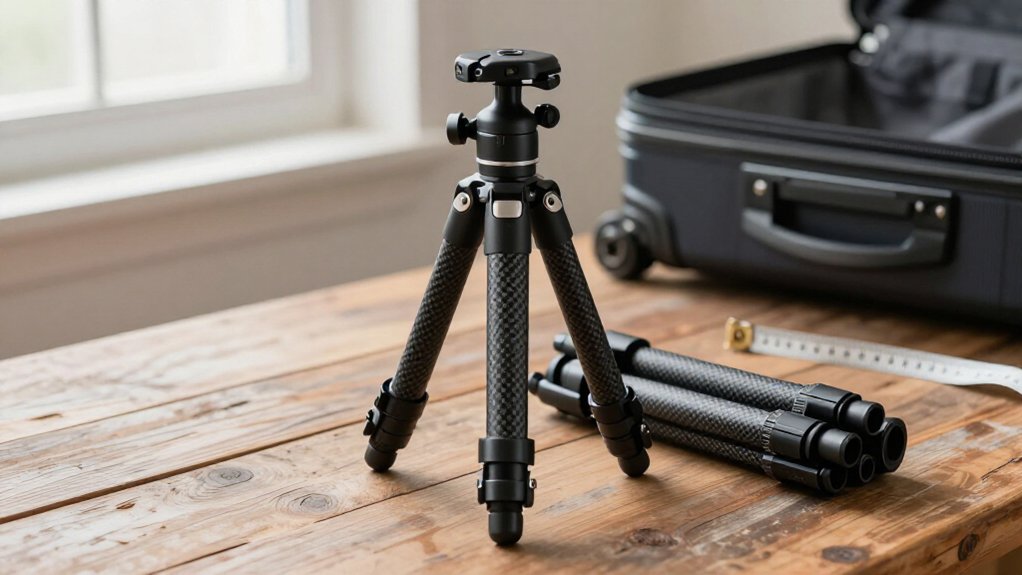
To check travel fit, fully collapse the legs, fold the center column, and place the head in its travel position.
Measure end-to-end along the tripod’s main axis, including protruding head, plate, and padding; don’t use maximum height.
Compare packed length with airline limits: common carry-ons allow 45 linear inches, while strict personal-item limits may require under 40 cm. Travel minis fold shorter than full-size or video models.
Check bundle width and padding too; further fit checks can help before flying.
Folded-Length Measurement Method
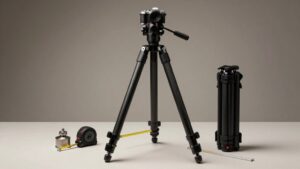
To measure folded length, collapse the legs fully, fold the center column as directed, and place the head in its travel position. Pull a tape straight along the tripod’s main axis from the outermost packed point to the opposite end. Measure end-to-end; don’t use the tripod’s maximum extended height, which describes a different dimension. Include protruding head and quick-release plate parts if they extend the packed profile.
A ball head or plate can add several centimeters or inches, so omitting either can understate the length that must fit.
Repeat the same setup each time: collapse the legs, fold the column, position the head, then measure. For a practical fit check, add folded width and height to the length as a rough packed-size estimate.
Common Airline Length Limits
For air travel, check how the airline calculates size: many carry-on limits use linear dimensions, adding length, width, and height, with 45 linear inches as a common cap. Compare your tripod’s folded dimensions with the airline’s formula, not its maximum extended height.
| Check | Practical effect |
|---|---|
| Carry-on example | 22 + 14 + 9 = 45 inches |
| Tripod example | 22 + 5 + 5 = 32 inches |
| Remaining allowance | About 13 inches for other contents |
| Ryanair personal item | 40 × 30 × 20 cm (15.7 × 11.8 × 7.9 in) |
Your tripod’s folded length and diameter both count. Under a 45-inch cap, its 32-inch share leaves little room in your bag, often forcing overpacking if you store it inside.
Budget-carrier personal-item limits are much tighter; many tripods are virtually impossible to bring free without careful folding and packing. Check your airline’s specific dimensions before you travel.
Folded-Length Units Explained
Folded-length specs use inches or centimeters to show how long a tripod is when collapsed, such as 15.51 in (39.4 cm) or 43 cm (16.9 in). You should compare folded measurement—not maximum extended height—with baggage limit. For a 40 × 30 × 20 cm personal-item allowance, the tripod’s collapsed length must fit within the 40 cm side; its height when opened doesn’t matter for that check.
A packed length under 40 cm (16 in) is a practical target for strict budget policies, while about 43 cm (16.9 in) may exceed free-carry limits. If a carrier assesses linear dimensions, length alone isn’t enough: include folded diameter or other required dimensions. Check units and conversion rounding before comparing figures. Use the same measurement for each comparison.
Folded Length by Tripod Type
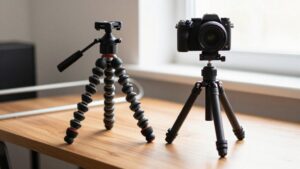
Folded length varies by tripod type: travel and tabletop models generally pack shorter than full-size and video tripods. Monopod-tripod hybrids can offer a compact alternative, but you’ll need to check their packed dimensions against your storage or carry limits. Compare each type’s closed length before choosing.
Travel Tripods
Travel tripods trade folded size against working height: mini models such as the Manfrotto PIXI EVO 2 pack to about 8.1 in (20.5 cm), while compact and average travel models commonly fold to 15–17 in (39–43 cm).
Check your bag’s packed length and diameter limits; folded height alone may not meet airline or backpack requirements. The Peak Design Travel Tripod folds to 15.51 in (39.4 cm); K&F Concept measures 15.35 in (39 cm), and Neewer LT32 reaches about 16.9 in (43 cm). Sirui Traveler models can close to 12.99 in (33 cm) while extending to 54.33 in (138 cm), showing how designs balance length and reach. Larger travel models may still fold near 15.3 in (39 cm). Aim below 18 in (46 cm).
Tabletop Tripods
For tabletop tripods, folded length matters more than maximum height because it determines how easily the tripod fits in a carry-on or personal-item compartment. Check the folded-length specification first, then consider folded diameter or bulk if the manufacturer lists it. A compact model can fit tighter spaces and leave more room for other gear.
Many bags follow an approximate 45-inch linear-dimension limit, calculated by adding length, width, and height; a short tripod makes that allowance easier to manage. In a typical 22 × 14 × 9-inch bag, the internal diagonal measures about 27 inches, but a tabletop tripod fits readily. For a small personal item capped at 40 × 30 × 20 centimeters (15.7 × 11.8 × 7.9 inches), target a folded length comfortably below 40 centimeters, or 16 inches. Maximum extension height rarely affects packing compliance.
Full-Size Tripods
Although a full-size tripod’s folded length is a useful starting point, its leg diameter and head shape also determine whether it fits your bag. Airline linear-inch limits account for the packed footprint, not length alone: estimate length plus folded width and height. For example, a 22 × 14 × 9-inch bag has a 45-inch limit.
A tripod folded to 22 inches with a roughly 5-inch diameter uses about 32 linear inches (22 + 5 + 5), leaving 13 inches for other packed items. For a fixed-size backpack, target a folded length of about 18 inches (46 cm) or less; its diameter reduces usable diagonal space. Check the head, plate, and folded legs against your bag’s internal dimensions. Typical 39–43 cm models may exceed strict 40 × 30 × 20 cm personal-item caps, so measure before packing.
Video Tripods
Video tripods vary in folded length by type, so compare their packed dimensions, not maximum height, when planning airline travel. Many standard full-size models close to about 15.5–16 inches (39.4–40 cm), but a fluid head or quick-release plate may add length or bulk. Measure the complete packed setup, including those parts, rather than relying on the legs’ published figure.
A wider folded profile also matters: a 22-inch tripod with a 5-inch diameter can occupy roughly 32 linear inches when you count length plus two width/height dimensions. That can use much of a 45-linear-inch carry-on allowance. For strict personal-item limits, a roughly 16-inch packed length may already be difficult once the head and diameter are included. If compact packing matters most, a mini tripod around 8 inches closed saves space, though you’ll trade away stability and payload capacity. Check the airline’s bag limits before packing.
Monopod-Tripod Hybrids
When packing a monopod-tripod hybrid, measure its folded length with the ball head and quick-release plate attached, and account for the folded legs’ width as well as their length. Don’t judge travel fit by maximum height: attached hardware and bundled legs determine the packed envelope.
For a 22-inch-style tripod, folded diameter adds effective linear inches; model bulk as length plus width and height when checking a typical 45-inch limit, before accounting for bag structure.
Ryanair personal-item dimensions of 40 × 30 × 20 cm leave little room; a nominal 20-inch hybrid is virtually impossible unless its packed length falls well below 40 cm. Aim for folded length no greater than 18 inches (46 cm), including head and plate, so the legs can fit within the bag’s diagonal space.
Prefer designs that let you remove the head or separate the legs; packing modules apart can keep the longest component within usable dimensions and reduce corner conflicts safely.
Allowance for Protective Padding
Allow space for protective padding when measuring your packed tripod, since foam or a hard case adds to its effective dimensions. Treat padding as consumed length, not empty clearance: if you target an 18-inch folded package for an internal diagonal fit, a padded sleeve can push the tripod beyond that limit.
When you use a soft pouch around the ball head, include its thickness in the packed diameter, length, and width. A personal-item allowance of 40 × 30 × 20 cm (15.7 × 11.8 × 7.9 inches) leaves little margin; just 1–2 cm of foam can create an overage.
Choose minimal, dense padding, concentrating it around sharp tripod feet and the QR plate area. Then measure the complete packed unit, rather than the bare tripod, against your airline’s stated limits before travel.
Collapsed Locking-Head Protrusions
Check the folded tripod’s locking head, collar, or tilt bracket for protrusions beyond the leg tubes. A collapsed head can still extend past the legs, making the manufacturer’s closed-height specification shorter than your tripod’s true packed length. Measure the bundle in its travel configuration, including any quick-release plate, leveling base, or adapter that sits proud of the head. Add the protruding head length to the folded leg diameter components when estimating linear dimensions.
For example, a tripod using 22 + 5 + 5 inches already consumes 32 linear inches, leaving little allowance for other items. If the rigid bundle exceeds your personal-item or carry-on limits, consider packing the ball head and plate separately from the legs. Measure the complete setup before relying on its listed folded length.
Overhead-Bin Diagonal Fit
Although a 22 × 14 × 9-inch carry-on has an internal diagonal of about 27 inches, a tripod can’t use that space like a straight rod: its folded leg bundle, ball head, and plate take up extra width and leave less room at the rounded corners. Treat the diagonal as a limit, not a guaranteed fit.
In a typical carry-on, usable space narrows near corners, while tripod diameter and head hardware occupy room beside its length. Keep effective packed length—folded length plus head and plate thickness—around 18 inches or less for a better chance inside a roughly 45-inch linear-dimension allowance. A 22-inch tripod may appear to fit the 27-inch diagonal, but its bulk can prevent insertion or require a larger bag.
Tube-Bundle Measurement Mistakes
For airline and bag fit, measure the folded length and tube-bundle diameter, not just the tripod’s closed height. A tripod behaves less like a flat rectangle than a bulky bundle: its tubes occupy corner space, so a diagonal fit can still block usable room.
- A 22-inch folded tripod with a 5-inch bundle diameter uses roughly 32 linear inches: 22 + 5 + 5.
- A 22 × 14 × 9-inch carry-on has a 27-inch diagonal, but the bundle reduces remaining room for other gear.
- For a 40 × 30 × 20 cm personal item, effective length above about 40 cm can exceed the limit; around 18 inches folded is a useful target to leave room for bundle width and rounded corners.
Judge bag compatibility by combined dimensions, not by height alone.
Verify Manufacturer-Stated Folded Length
When comparing tripods for travel, verify the manufacturer’s stated folded length in the spec sheet, often labeled “closed,” “packed,” or “transport” length, because brands may measure the ends differently.
Use this figure for bag fit, not maximum height. A tripod rated 54–64 inches tall can still exceed your packing limit when folded. Compare the complete packed package, including its diameter where relevant.
- Confirm what the listing measures: Peak Design’s Travel Tripod lists 15.51 inches (39.4 cm) closed height; K&F’s 64-inch model lists 15.35 inches (39 cm) closed size.
- If sources disagree, check whether the ball head, mounting plate or QR base, and center column extension are included.
- Under about 18 inches (46 cm) is a common bag-fit heuristic; test your own actual bag first.
Conclusion
Before you pack, measure your tripod in its true travel configuration, including the head, locks, feet, and any padding. Compare that total with your airline’s current limit; don’t assume a diagonal fit will be accepted. Check the stated units and confirm the manufacturer’s folded-length method, since tube-bundle measurements can understate the packed size.
If you’re near the limit, remove or reposition accessories, protect protrusions, and verify the final fit in your intended bag before leaving.
Tripod Price Estimator: What Should You Pay?
See the typical price range for camera, phone, travel, video, mini tripods and monopods from a dated Amazon shelf snapshot, and check your budget.
Camera-to-Tripod Mount Finder (1/4" vs 3/8")
Pick your camera and tripod stud to see its tripod socket thread (1/4"-20 or 3/8"-16), whether you need an adapter, and the manual source.
Light Stand Height & Payload Picker
Enter fixture and modifier weight, needed height and a safety margin to get the minimum light stand payload and height, plus matching stands.
Phone Tripod Height & Clamp-Fit Finder
Work out how tall your phone tripod must be and how wide its clamp must open, then see listed tripods that meet both.
Mini Tripod Weight-Fit Checker
Add up your camera body, lens and accessory weights and see which mini tripods in our data list a capacity that covers your setup.
Travel Tripod Height & Pack-Size Calculator
Work out the legs-only max height and the folded length your travel tripod needs from your eye height, head, camera and bag size.