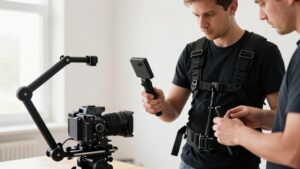
Gimbal vs Steadicam: Motorized vs Mechanical Stabilization Compared
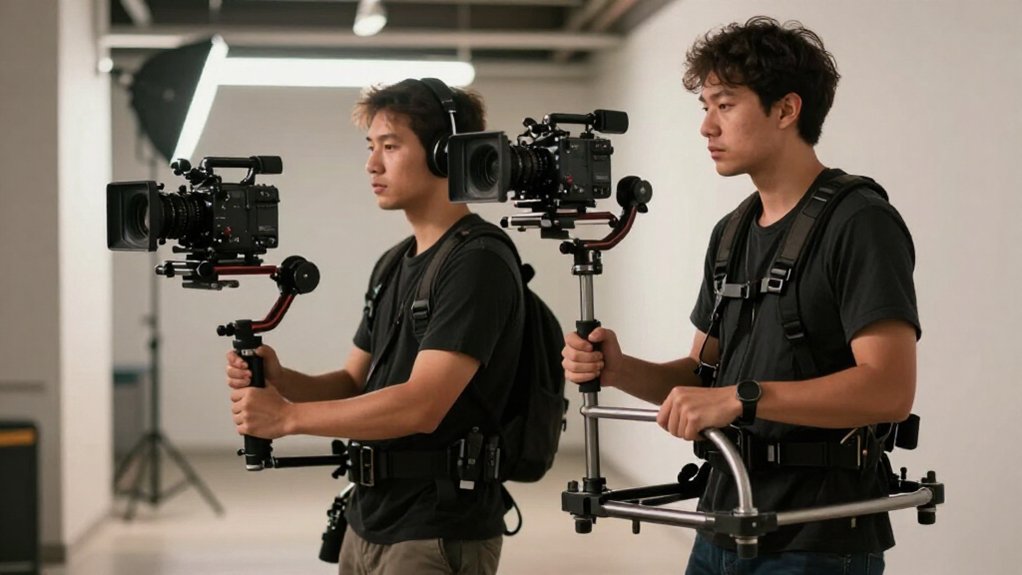
A gimbal uses IMU sensors and brushless motors to correct pan, tilt, and roll, keeping your frame level through turns and pace changes.
You’ll get a dolly-like glide, though motors must carry your camera’s weight.
A Steadicam balances a sled with counterweights while its arm and vest absorb your steps, shaping a floating path.
Your choice depends on the movement you want, and the setup, skill, and demands.
The next section can guide your choice.
Motorized vs. Mechanical Movement
A gimbal uses gyroscopes and IMU sensors to detect movement, then drives brushless motors on its pan, tilt, and roll axes to counter it in real time: often thousands of adjustments per second. You feel the correction as the frame stays level through a sharp turn or a sudden change in pace; the motors respond faster than your hands can.
A Steadicam takes another route: its sled balances with counterweights, while an isolating arm absorbs your body’s movement. It doesn’t electronically correct the horizon; your posture, momentum, and starts and stops shape the camera’s floating path.
| System | Movement |
|---|---|
| Gimbal | Sensor-driven |
| Steadicam | Operator-shaped |
Choose a gimbal for quick run-and-gun moves; with practiced balance, a Steadicam can give you a more organic, cinematic drift across the scene.
Gimbal Motors and Steadicam Counterweights
That floating look comes from two very different sources: brushless gimbal motors make tiny, continuous corrections across the pan, tilt, and roll axes, guided by gyroscope and IMU feedback, while a Steadicam’s counterweights balance the sled so gravity steadies the camera and an isolating arm softens your movement.
For a mirrorless rig, motors must carry the full load; add a lens or active tracking, and you’ll need greater battery capacity. Many gimbals top out around 1.5–2 kg, so check your build before filming.
For heavier cinema packages, you may choose a vest-and-arm Steadicam. Tune its counterweights until the sled balances; poor weight distribution can cause horizon drift. Your payload and operating needs decide which system fits the shot before you step onto set.
Motion Smoothness and Natural Feel
As you walk into a moving shot, a gimbal’s IMU sensors and brushless motors make continuous pan, tilt, and roll corrections, often giving footsteps a steady, dolly-like glide. Your gimbal keeps framing composed through sudden turns; its stabilization avoids sensor cropping.
Yet if you add digital stabilization on fast moves, the image can develop a jelly-like wobble.
Steadicam motion tells a different story. Its arm and vest isolate your body movement, while counterweights and a sled let the camera float with subtle, human-guided sway. You can feel your intent in each arc, giving planned moves a cinematic rhythm that feels less digitally perfect, though not as uniformly controlled.
Choose the gimbal when unpredictable walking or running demands consistent smoothness; choose a well-operated Steadicam when you want a lifelike, operator-driven glide. On a fast track, that difference shapes whether your frame feels locked to the path or carried by a human camera operator.
Balancing and Calibration Time
Before the first take, a gimbal asks you to slide the camera until each axis holds its position, then run an IMU calibration so its motors know where neutral is. Slide the plate and move counterweights until every axis stays put when you release it; the minutes you spend become repeatable with practice.
Power up, make a slow test move, and watch for hunting or oscillation before the shot begins.
A Steadicam asks you to balance its sled with counterweights and trim until the camera neither tips nor drifts. That hands-on setup can take longer. Walk, start, and stop to check horizon stability.
Once dialed in, mechanical balance gives you a floating feel with heavier payloads; a gimbal usually gets you shooting sooner overall.
Lens Changes During Takes
A lens swap mid-take can shift the camera’s center of gravity before the next move.
With a gimbal, you may manage a quick partial change, but altered payload disrupts pan, tilt, and roll balance. Motors can mask a small shift briefly, yet a heavier lens often demands rebalancing and recalibration; otherwise, the horizon may hunt as you track through a doorway.
A Steadicam lets you plan swaps between sections or during a pause.
Adjust sled counterweights and arm balance for the new camera-lens pairing, then check neutral pitch to keep the frame floating instead of drifting.
For either rig, change lenses between takes when possible. Keep a gimbal within its rated payload; a larger lens calls for new settings and balance before smooth tracking.
Battery Life and Charging
When the take stretches past golden hour, a gimbal’s battery can become part of the shot plan. Typical consumer gimbals promise 8–12 hours, but expect 20–30% less in the field when you mount a heavier mirrorless camera. Active AI tracking and frequent mode changes draw more power, so watch the indicator between setups rather than trusting the headline rating.
Pass-through charging can keep the motors running while you shoot tethered to a charger; removable batteries let you swap quickly instead of waiting through a recharge.
A steadicam takes a different rhythm: its mechanical balance needs no motors or electronic correction, so operation won’t drain a stabilizer battery. Your camera still needs its own power. Plan charging around the scene, not just the spec sheet.
Tight-Space Access
In a narrow hallway, a handheld gimbal slips through doorways and makes quick turns with little setup. Track a subject through a side room, pivot, and recover the frame without waiting for a vest-and-arm rig. Its compact form helps you move spontaneously when event coverage leaves no time.
A Steadicam’s arm, vest, and sled need room to swing; in a corridor, they can catch walls or furniture. You can still guide one through with practiced starts and stops, but you’ll need to plan each step, preserve the horizon, and watch the sled’s clearance. That measured choreography can slow a fleeting shot.
Choose the gimbal when the path pinches and agility matters; save the Steadicam’s floating movement for a space where its arm can travel freely.
Payload Capacity and Rig Weight
As you move from a tight hallway to a wide tracking shot, your camera package determines which rig can carry the frame. A gimbal’s payload rating limits the camera, lens, battery, and accessories its motors can stabilize; a mirrorless build may fit within the 1.5–2 kg class, while heavier cinema rigs can overwork the motors.
A Steadicam carries weight through a balanced sled and matched arm and vest, shifting the limit from motor torque to your ability to control the total rig.
Payload Limits
A gimbal’s payload limit is a hard ceiling for its motors: mirrorless and DSLR models often top out around 1.5–2 kg, while phone gimbals handle roughly 260–400 g and action-camera models typically stay below 150 g.
Treat it as a working boundary, not a target: once you exceed it, or demand too much torque, motor corrections weaken. The horizon may sag, vibration can creep into a move, and a pan that should glide can tilt under pressure. Even below the stated limit, lens length and weight distribution can challenge the balance window.
- Check your package against published rating.
- Balance each axis before powering up.
- Match heavier cinema builds to a Steadicam arm, sled, and counterbalance.
That choice keeps your frame composed cleanly in motion.
Total Rig Weight
Before you choose a stabilizer, weigh the entire rig—camera, lens, battery, and accessories. That figure, not the bare camera body, guides your choice. Phone gimbals often support about 260–400 g; action-camera models typically handle less than 150 g, while mirrorless and DSLR gimbals can carry roughly 1.5–2 kg.
A lightweight mirrorless build may glide comfortably; a lens, monitor, and battery can push it toward the limit, where smoothness and runtime suffer. Though consumer models may be rated for 8–12 hours, heavy use can cut that by 20–30%.
A Steadicam has no motor-runtime ceiling, but its arm, vest, and sled must match your package. You’ll need precise counterweight balancing and training to prevent horizon drift and wobble. For heavier cinema rigs, a correctly tuned mechanical setup may feel more natural.
Wedding and Event Filming
For ceremony coverage, you can use a Steadicam’s balanced, floating movement to glide through a long entrance, while a gimbal quickly smooths handheld reframes. At the reception, its active three-axis motors help you track guests and catch fast-moving moments with a lightweight mirrorless kit.
Choose your stabilizer by the shot: a Steadicam for rehearsed, complex paths, or a gimbal for nimble run-and-gun coverage.
Ceremony Coverage
As the couple moves down the aisle, a three-axis gimbal steadies your walking shot, correcting pan, tilt, and roll in real time to keep the horizon level and the frame composed. That control lets you track vows and processions solo, while smart subject tracking keeps the couple centered through quick reframing.
- Match the rig to your camera: phone gimbals carry about 260–400 g; mirrorless and DSLR models handle roughly 1.5–2 kg.
- Budget power: an 8–12-hour rating may fall 20–30% under heavy loads or AI tracking, so plan charging before the ceremony.
- Choose a Steadicam for a natural floating long take only if you can balance it and control starts, stops, and horizon drift.
Its vest-and-arm isolation rewards operators; you’ll get graceful, uninterrupted ceremony movement.
Reception Run-and-Gun
Across a lively reception, a gimbal lets you unfold, balance, and start filming quickly, then smooths walking shots and moving B-roll with real-time pan, tilt, and roll correction.
At the dance floor, you’ll slip between guests for candid reactions, then follow a couple through crowded tables without losing the scene’s momentum. Brushless motors read gyroscope and IMU data to counter movement instantly, so your posture and imperfect starts matter less than with a Steadicam.
A Steadicam can give long takes a naturally floating feel, but you must balance its sled and vest, control starts and stops, and watch horizon drift amid unpredictable turns.
With a compact mirrorless or DSLR rig, a gimbal suits solo table-to-table coverage quickly. Manage power; heavy rigs shorten reception runtime.
Choosing Your Stabilizer
Once reception coverage reveals how quickly moments unfold, your stabilizer choice comes down to speed, control, and the shots you want. For walking reactions and sudden embraces, a three-axis gimbal uses gyros and brushless motors to steady pan, tilt, and roll without months of practice. With a mirrorless camera, check payload: larger models often support about 1.5–2 kg with lens, mic, and accessories.
- Choose a gimbal with quick orientation switching and quick-release plates; you’ll move from aisle walk to portrait framing without losing a beat.
- Solo shooters can use AI subject tracking, but budget for battery: an 8–12-hour rating may fall 20–30% under tracking’s load.
- Pick a mechanical Steadicam only if you can practice and want its human-controlled floating glide for rehearsed moves.
Choose by Operator Availability
Who’s behind the camera can shape the shot as much as the gear. If your crew has little training time, choose a gimbal: its motors correct walking and grip errors, so you can reach usable footage after setup. Working solo? AI tracking can frame your subject when your technique isn’t polished, and the easier learning curve helps when you swap operators or cameras on a tight schedule.
A steadicam asks more of its operator. You’ll need someone experienced to balance the sled and vest, manage starts and stops, and keep horizon drift in check. In skilled hands, its isolating arm can create a floating, natural movement that motor correction can’t reproduce.
Choose by crew: favor speed and flexibility with a gimbal, or practiced control with a steadicam.
Conclusion
Choose a gimbal when you need quick, motorized control and can manage battery, calibration, and payload limits. Choose a Steadicam when you want organic motion, lens changes without rebalancing, and have a trained operator.
Picture the final shot: a gimbal glides through a tight aisle; a Steadicam floats down it with a more natural drift. Match the rig to your space, camera, and crew. The best stabilizer is the one that keeps your move smooth: and your story in focus.