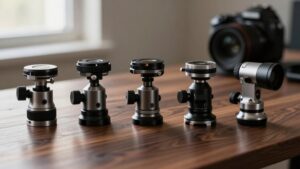
Ball Head vs Pan-Tilt Head: Speed or Precision for Your Photography?

Choose a ball head when you need fast reframing, tracking, or quick portrait adjustments; its single lock frees the camera in any direction.
But small moves can shift your horizon, so you may need to re-level.
A pan-and-tilt head separates axes, giving you finer framing and less cross-axis drift, though its multiple controls slow adjustments.
Check plate compatibility and choose a payload rating above your camera-and-lens weight.
The sections ahead explain each design’s fit.
Quick-Release Plate Compatibility
Quick-release plates speed up camera changes, but they aren’t universally compatible: the plate must match the head’s mounting thread and clamp system.
Check whether your head uses a 3/8-16 or 1/4-20 screw port; larger heads commonly use the former, while smaller heads often use the latter.
| Head or plate | What to verify |
|---|---|
| Larger head | 3/8-16 port |
| Smaller head | 1/4-20 port |
| Arca-Swiss | Matching plate and clamp |
| Any system | Width, thickness, locking style |
Arca-Swiss is widely supported, but confirm both components use that standard.
Even within Arca-Swiss, differing plate thicknesses and clamp designs can prevent a secure lock. Check clamp width and locking style before purchase.
A compatible ball or pan-tilt head lets you attach or remove your camera quickly, supporting faster setup changes during shoots.
Horizon Leveling Behavior
Plate compatibility determines how quickly you can mount a camera; head design affects how reliably you can level it. With a ball head, you release one knob and move the camera in any direction. Because tilt and pan occur together, a small adjustment can shift your horizon.
After repositioning, you’ll need to check and correct the level again.
A pan-and-tilt head lets you adjust horizontal and vertical axes separately. You can change vertical angle with less effect on horizontal alignment, so the horizon stays more consistent during framing. Independent axis control also reduces frame drift during micro-adjustments.
If you add a leveling base, you can improve alignment, particularly while panning. Choose a ball head for fluid repositioning; choose pan-and-tilt when horizon precision matters more.
Locking Mechanism Design
A ball head uses one main locking knob to secure pan, tilt, and roll at once, so loosening it frees the camera to move in any direction. That gives you quick repositioning, but any adjustment can shift other axes before you retighten the knob. A separate tension or friction control lets you regulate ball movement during setup, though it doesn’t isolate axes.
A pan-and-tilt head uses separate controls for each axis, so you can loosen one direction while keeping the others locked. This reduces cross-axis drift when you make fine adjustments, which helps you preserve framing and level. However, you must operate and tighten multiple knobs or handles, making the system more complex and usually slower for you than a ball head’s single-lock design.
Locking Knob Placement
Manufacturers typically place a ball head’s main locking knob near its center, making it easy to unfasten, reframe, and relock all axes with one control. This layout suits you when you need quick adjustments: loosen the knob, reposition the camera, then tighten it again. A pan-tilt head places separate controls by axis, letting you change tilt or pan without disturbing the other plane.
You’ll make more individual adjustments, but the controls provide finer directional isolation.
Long handles can protrude from pan-tilt heads, where they may snag branches or catch your camera strap. Ball-head controls generally enable faster unfasten-reframe-lock cycles, though you must tighten the single knob correctly; loose tension can let the camera drift. Check each model’s control placement and ergonomics, since designs vary.
Camera-and-Lens Payload Limits
Because a head’s payload rating indicates the load it can support, choose one rated above your camera-and-lens weight to reduce sag or creep as you release it.
Heavier telephoto setups make these limits more apparent. A gimbal head supports balanced heavy loads, while a ball or pan-tilt head may feel less stable near its rating. When you loosen a ball head, the camera can move in any direction, increasing drift risk near capacity.
A pan-tilt head usually unfastens one axis at a time, helping you limit unintended movement. Check the mounting interface, too: larger heads often use 3/8-16 ports, while smaller models commonly use 1/4-20. The wrong adapter or an insecure quick-release plate can compromise support.
Total weight isn’t the only factor; a front-heavy telephoto lens can stress the tilt axis. Position the lens and plate to support extended lenses properly, particularly when you use a long lens at full extension.
Weather Sealing and Corrosion
After checking load capacity, consider how each head handles moisture and corrosion. Neither head type is truly weatherproof. For rain, spray, or mist, choose stainless steel or well-sealed aluminum parts and a waterproof cover.
Corrosion concentrates at moving interfaces: ball sockets and chrome contacts on ball heads, and pan-tilt bearing surfaces. Frequent wet loosening can cause galling or gritty locking.
Pan-tilt designs expose more knobs, shafts, and hardware, which collect grit and water; wipe them down and re-grease regularly. Ball heads have fewer external controls, so you can keep them cleaner, but dry the socket to prevent stiffness or rust.
After salty spray, rinse with fresh water and dry fully before locking. Trapped salt and moisture can permanently reduce smoothness, even with corrosion-resistant materials.
Ball Head Reframing Drift
When you loosen a ball head’s single locking knob, the camera can move in any direction, so even a small adjustment may shift your pan, tilt, or horizon. Gravity can then creep a slightly loosened setup, making the framing or horizon shift noticeably, particularly with a heavier DSLR or long lens.
Unlike a pan-tilt head’s separate axis controls, the ball head’s single knob releases all axes together. A small tilt correction can thus disturb your pan framing, so you’ll need to recheck more than the intended movement.
Tension adjustment can limit free movement, but too little friction lets the ball slide, while too much can make you jerk the camera as you reposition it. Relock after each change to prevent cumulative drift during composition.
Advantages and Disadvantages of Each Option for Panoramas
For panoramas, a ball head’s single control lets you align and rotate the camera quickly, but it offers less deliberate control over each axis. A pan-tilt head lets you adjust pan and tilt separately for precise, consistent framing, though separate locks slow adjustments between overlapping frames.
Your choice depends on whether speed or axis-by-axis precision matters more.
Ball Head Trade-Offs
A ball head speeds up panorama capture: free one main knob, rotate the camera across the horizontal plane, often through 360 degrees, and relock it for each frame. That single-control workflow can help you move quickly through a sweep and maintain consistent overlap for stitching. It also suits field use: you can rotate rapidly, including when aligning a nodal-point setup, without a complicated adjustment sequence.
However, loosening the ball releases more than pan: tilt and roll may shift, so you must recheck the horizon and level between frames. Even small changes can complicate stitching or introduce parallax, particularly across nearby foreground subjects throughout the full panorama sequence.
- Fast rotation reduces capture time.
- Check level after every reposition.
- Nodal-point alignment remains practical.
Pan-Tilt Head Trade-Offs
Unlike a ball head’s single-knob workflow, a pan-tilt head lets you adjust vertical tilt without changing horizontal pan, making it easier to align horizons across panorama frames. You can correct a tilted horizon while preserving your pan angle. However, you’ll adjust pan and tilt in separate steps, so framing each image takes longer than loosening one ball-head knob and rotating the camera.
A ball head supports faster re-framing and makes it easier to keep your setup moving toward a nodal-point pan. The pan-tilt head’s precision consequently comes at a speed cost in practice. On panorama hikes, its protruding handles can catch on straps or branches as you reposition. Choose pan-tilt when horizon consistency matters most; choose a ball head when quick re-framing matters more.
Tracking Fast-Moving Wildlife
When you track fast-moving wildlife, a ball head lets you re-aim quickly with one knob, while a 3-way head requires separate pan and tilt adjustments. You’ll gain more deliberate framing with a 3-way head, but a ball head’s tension control helps maintain smooth panning without letting the camera drift.
For heavy telephoto lenses, a gimbal can provide steadier tracking, while a ball head suits lighter setups and rapid reframing.
Rapid Subject Tracking
For fast-moving wildlife, a ball head usually tracks faster than a pan-tilt head: one knob lets you free, reposition in any direction, and relock with fewer steps. You’ll still react quickly when an animal changes direction because you free once, aim across axes, and relock. A pan-tilt head separates pan and tilt locks, so you can correct one axis without shifting the other, but each adjustment may add time during sudden movement.
- Use a ball head when reaction speed matters more than isolated axis control.
- Adjust friction to limit drift while keeping repositioning quick.
- For a heavy telephoto setup, consider a gimbal head, which balances the camera around its center of gravity.
Between these, choose the ball head to reduce re-aim steps.
Smooth Panning Control
Fast re-aiming helps track wildlife, but smooth panning also depends on how the head controls movement. With a ball head, you loosen one central knob, move the camera quickly with the animal, then lock it once you’ve framed the shot. That single control supports rapid tracking, but a loose ball can let the horizon shift with your movement.
Set tension or friction so the camera travels freely without drifting too far before you lock it.
A pan-and-tilt head separates pan and tilt, giving you more controlled movement; adjustments on one axis are less likely to disturb the horizon. However, separate locks can slow tracking and require more handling. For tracking with telephoto gear, a gimbal balances weight near its center of gravity, reducing resistance.
Precise Reframing
As a fast-moving animal changes direction, a ball head lets you re-aim quickly with one main knob, while a pan-tilt head offers more precise control over each axis. With a long lens, prioritize load stability and smooth locking; ball heads often include tension adjustment to limit drift as you reposition. Keep the ball head slightly loose for rapid movement, then tighten when framing nears your target.
A pan-tilt head locks pan and tilt separately, so a small tilt correction won’t shift your horizontal alignment, but each adjustment can take longer.
- Choose a ball head when unpredictable movement makes speed outweigh fine alignment.
- Use separate pan-tilt controls when horizon or frame-edge accuracy matters.
- Recompose as wildlife moves; timing often beats ultra-fine precision in practice here.
Portrait Orientation Reframing
When you switch to portrait orientation, a ball head lets you re-aim the camera quickly with one knob, while a pan/tilt head lets you adjust one axis at a time to preserve leveling and refine composition.
A ball head often suits quick minor reframing between shots: you loosen its locking knob and reposition the camera in one motion. Yet because the ball can move in every direction, even with slight release, you may need careful micro-corrections to restore framing and level.
A pan/tilt head takes longer to reposition, but you can lock pan and roll, then make small tilt changes without repeatedly disturbing the horizon. Many pan heads provide a dedicated 90-degree portrait workflow through their base or geometry; a ball head typically uses a drop-notch and plate repositioning for vertical framing. Choose the ball head for speed, or the pan/tilt head when controlled axis-by-axis corrections matter more for consistent composition and leveling across successive portrait shots in varied settings.
Conclusion
Choose a ball head when you need fast, versatile reframing and accept that tightening one lock can shift your composition. Choose a pan-tilt head when you need independent axis control, repeatable horizon leveling, or precise panorama adjustments.
Before deciding, verify quick-release plate compatibility, payload capacity, knob access, and orientation changes with your camera and lens. For wildlife, prioritize tracking speed; for portraits, compare the effort of reframing vertically. Choose the head that fits your workflow.