Are Carbon Fiber Tripods Worth It? Who Should Pay the Premium
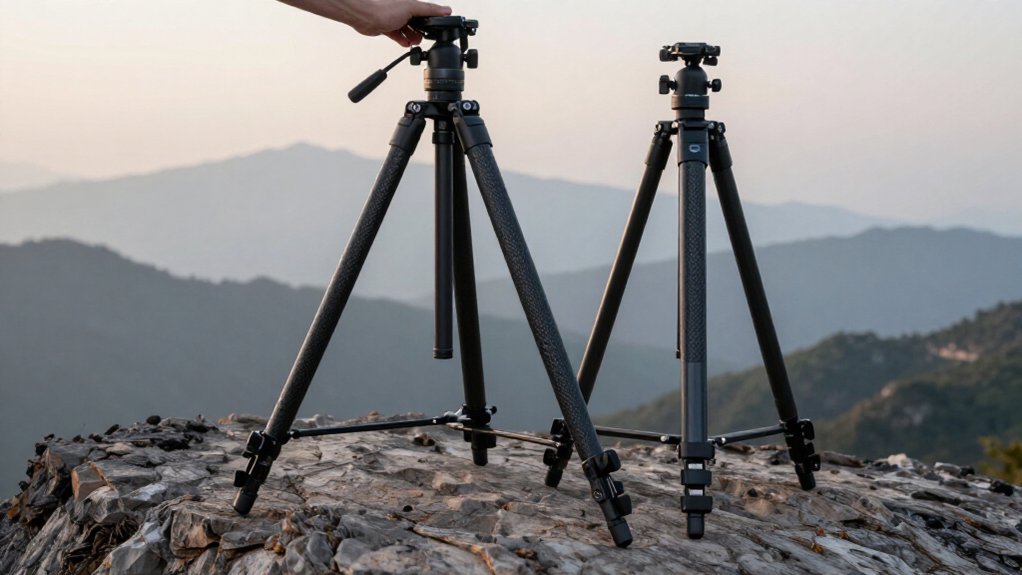
Carbon-fiber tripods are worth the premium if you hike, travel, or shoot long exposures, valuing lower weight and quicker vibration settling. Compared with aluminum, carbon costs 30–50% more, yet it can damp bumps sooner; wind still moves both, and a ballast bag may help during 5–10-second exposures.
Choose aluminum if budget matters more than weight. Column design, head compatibility, repair costs, and glove-friendly locks affect whether the upgrade suits you. Further comparisons can help you choose.
Long-Exposure Vibration Control
For long exposures, a carbon fiber tripod’s main advantage is how quickly it settles after a gust, shutter press, or small bump. Its greater stiffness and vibration damping can stabilize your camera sooner than an aluminum setup, reducing oscillations that soften detail during exposures. In wind, this matters even when airflow remains the dominant source of movement.
Yet carbon fiber won’t eliminate shake from gusts or unstable ground; your results still depend on your setup.
For exposures of five to ten seconds, a ballast bag may improve stability more than changing tripod material, because mass reduces wobble. If you’re hiking or traveling with long-exposure gear, carbon fiber can offer vibration control per unit weight. That benefit may justify its premium, not raw strength.
Airline Carry-On Limits
When airline limits matter, a carbon-fiber tripod’s carry-on advantage often comes down to folded size more than weight. A lighter tripod helps with weight caps: carbon travel models weigh 0.9–1.0 kg, while aluminum alternatives can be heavier.
But airlines usually judge whether it fits by its packed length and your bag’s dimensions. Models folding to roughly 39–43 cm, such as Peak Design or Freewell, can fit inside camera bags.
If your carrier limits cabin baggage length to 55–56 cm, a tripod around 45–46 cm, such as the Benro Cyanbird, leaves more margin than a longer design. Compact packing reduces unused space; Peak Design minimizes dead volume around its center column and legs.
For flights, carbon fiber earns its premium when the tripod fits your carry-on dimensions; weight savings alone don’t guarantee acceptance.
Leg-Lock Usability With Gloves
With gloves on, prioritize leg locks you can operate by position and grip rather than touch alone. Twist locks with marked angle detents give repeatable leg positions when reduced tactile feedback makes alignment uncertain. Larger lock rings also turn more confidently than narrow collars, especially with insulated gloves.
| Feature | Practical advantage |
|---|---|
| Marked detents | Repeatable angle selection |
| Broad lock rings | More secure grip |
| Chest-level adjustment | Less fine tuning |
Before buying, test locks on a counter while wearing gloves. Open and close each leg, then check whether you can snug every lock decisively without slipping or needing a second turn. Compare this with chest-level height adjustment, which can reduce fine tuning and reliance on maximum extension. If clamping isn’t repeatable, the design won’t suit you.
Carbon Fiber Layup Quality
When you compare carbon-fiber tripods, check fiber orientation, resin quality, and how consistently each layer is applied. Precise layup and controlled curing can reduce voids and misalignment, improving rigidity and vibration control.
You’ll often pay more for tighter quality control, so inspect the finish for visible defects that may signal weaker construction.
Fiber Orientation
A tripod’s carbon-fiber layup, the orientation and stacking of its fiber layers, matters more than the carbon count alone.
Because carbon is strongest along its fibers, manufacturers arrange layers to resist bending and twisting. A well-engineered pattern can keep extended legs and a twisted head more rigid than a less suitable pattern, even when both tripods use similar amounts of carbon. Some models use ten-layer weaves, but layer count by itself doesn’t establish performance; alignment and placement matter.
At maximum extension, poor alignment or stacking defects can allow extra flex, vibration, or wobble under load. Premium models typically reflect more engineering in fiber placement and quality checks, not simply greater carbon volume. You can compare rigidity under the same load and leg extension to judge differences.
Resin Quality
Even a well-oriented carbon-fiber layup can underperform if its resin doesn’t wet the fibers fully or cure evenly. Resin quality determines how epoxy bonds the plies. Poor wetting or incomplete curing can leave voids and weak spots, reducing stiffness and making rigidity less predictable under load.
Higher-end tripods use controlled curing, which limits defects and helps the structure resist delamination. During quality control, inspect internal surfaces for voids, uneven bonding, or separation between plies; these flaws can weaken vibration control and durability.
Compared with a cured layup, lower-quality resin may make your tripod feel less solid when you’re extending and tightening it, and performance may drift over time. You can’t judge resin quality from fiber orientation, so consider curing controls and inspection before paying a premium.
Layer Consistency
Carbon-fiber tripods can feel noticeably different despite similar weights because manufacturers vary fiber counts, weave patterns, and resin systems. A roughly 1.5-kilogram model may resist twisting better than another in the same class because its plies align more consistently and cure under controlled temperature, pressure, and timing. Those production controls help the tubes deliver their intended stiffness across sections rather than allowing uneven flex or settling.
A tripod that shifts noticeably may not match its advertised rigidity, even when its stated payload equals a rival’s 10,000-gram rating. Joint design matters too. A secure locking system, such as Manfrotto’s M-lock on the Befree GT, can help preserve tube stiffness in use. When you pay extra, compare real-world torsional stability, not weight or payload claims alone.
Finish And Defects
Beyond stiffness and joint stability, inspect the finish for clues to how carefully the tripod was made.
Manufacturers layer oriented carbon-weave plies and cure resin under controlled conditions; consistent layup limits voids and misaligned fibers. Because composites can delaminate or trap air, defects may change stiffness and vibration behavior; tolerances and inspection matter.
The process demands labor and equipment compared with aluminum extrusion, so premium models receive more production control and quality checks. Look for spotty finishes, uneven surfaces, chips at edges, or soft-looking clear coats near joints; these may signal poor layup or curing.
On carbon, damage that exposes disturbed fibers or cracks is a stronger warning than an equivalent aluminum scuff, since sharp impacts can fracture the composite and repairs may prove unreliable. A clean finish supports confidence, but it can’t confirm internal integrity without careful inspection.
Center-Column Macro Positioning
When you invert or pivot the center column, you can position your camera below the height your tripod legs allow, enabling low-angle and macro shots. Check stability with the column extended or inverted, since added leverage can increase movement; compare this behavior on carbon-fiber and aluminum models.
A premium design makes the most difference when you regularly shoot close-ups and need to reframe without changing your leg spread.
Invert the Center Column
For macro work close to the ground, an invertible center column can lower your camera beyond the tripod’s normal minimum height, helping you frame around foreground obstacles. Look for models that reverse or pivot the column; the K&F Concept TC2534 explicitly supports inversion for macro and special photography. Check that the inverted camera clears the ground and that the column lock stays firm; extra positioning range can reduce steadiness at the bottom.
Some tripods, including the Vanguard VEO 3+ 303CBS, advertise pivoting columns, which can expand macro-style framing without fully removing the column. Before shooting inches above the ground, verify the tripod’s load rating and head mount can secure your camera and lens. Inversion changes camera placement, not the tripod’s maximum reach.
Achieve Low-Angle Shots
Check a carbon-fiber tripod’s minimum height and center-column design before choosing it for macro work. A pivoting or removable column lets you position the camera below the usual leg spread without replacing the tripod. The Vanguard VEO 3+ 303CBS pivots its center column; the 3 Legged Thing Winston 2.0 removes it and supports inversion.
For compositions almost at ground level, compare models that explicitly allow inverted shooting, such as the K&F Concept TC2534. Also check the listed minimum operating height: the Neewer LiteTrip LT38, for example, reaches 15 cm, which can suit tight ground-level framing.
A swing-away or removable design can make shifts from standard framing to macro positioning simpler. Choose the mechanism that matches your working height and how often you’ll reconfigure it; a low minimum height and flexible column solve different access needs when selecting a carbon-fiber tripod.
Check Macro Stability
Test a tripod’s center-column stability at its lowest macro-ready height, since small shifts can become obvious at high magnification. Choose a model that removes or inverts its column for a low working position; the Winston 2.0, for example, reaches about 23.1 cm with the column removed or inverted.
Check whether a repositionable column locks without flex: Vanguard’s VEO 3+ 303CBS offers pivoting for low-angle setups.
At that lowest usable configuration, mount your camera and twist it to expose column movement separately from leg stability. Designs can claim low-angle capability yet differ in how reliably the head and column lock under load. Compare behavior rather than relying on feature labels. Then you’ll focus once and recheck framing; small shifts show clearly at high magnification.
Compare Carbon and Aluminum
After checking low-position stability, compare carbon fiber and aluminum by column design before judging the material.
Carbon and aluminum both support center-column macro work when you can remove, invert, or pivot the column. Some carbon models include these mechanisms.
For this use, the key specifications are minimum operating height and column configuration, since you need to hold the camera steady at low angles. Carbon fiber weighs less for travel and crouching setups and damps vibration, helping the tripod settle faster.
Yet sharpness also depends on stiffness, head fit, and secure leg and column locks.
Choose aluminum for value if weight savings aren’t essential; carbon often costs 30–50% more. Choose carbon when frequent travel and a dedicated low-angle mechanism justify its 0.9–1.6 kg range.
Head Compatibility and Payload Limits
A carbon-fiber tripod’s practical payload depends on both its legs and its head: a kit rated for 10 kg can still wobble if its ball head flexes under a heavy camera. Compare the leg rating with the head’s stated limit, and use the lower figure as your ceiling. K&F Concept TC2534 and Manfrotto Befree GT advertise roughly 10,000 g, but that number doesn’t guarantee their included heads will hold your camera, lens, and head without creeping or wobbling.
The Freewell FW-T1 illustrates the distinction: its legs are rated to 8 kg, while its head is rated to 5 kg. That’s a more realistic match for a light Canon 5D Mark II setup than a large telephoto combination, unless you fit a stronger head. Ball heads suit general photography; near maximum extension or heavier loads, prioritize head stiffness and secure locking. Test your setup at your intended height, particularly full extension, where flex and instability show.
Tripod Parts and Repair Costs
When impact damage occurs, carbon-fiber legs can crack rather than bend, often requiring a section replacement or even a new tripod. After a sharp point strike, you may find that a cracked tube or damaged insert can’t be straightened safely; replacing the affected leg section is the usual route. Aluminum legs more often bend or dent under stress, yet they may remain usable, so rough handling typically costs less to fix.
On a carbon model, parts and labor can approach the price of replacing the whole tripod, especially if several legs or fittings are damaged. Check whether the center column comes out: if only that component fails, a removable design may let you replace the column instead of the entire support. Both materials need routine care, but carbon’s main repair-cost risk is impact cracking, not corrosion. Factor that exposure into your ownership cost over time.
Check Warranty Exclusions Carefully
Before buying a carbon-fiber tripod, check whether its warranty excludes drops, impacts, point loads, or other “misuse,” since a sharp strike can crack composite legs.
Compare exclusions across models before you pay a premium. Check whether repairs, replacement legs, center-column changes, or non-OEM feet void coverage; a modification could leave you paying for a later failure. Verify how the policy treats metal clamps and columns: carbon resists corrosion, but hardware may not share that protection.
- Confirm the coverage period and definition of manufacturing defects.
- Ask whether delamination or internal voids qualify, rather than cosmetic flaws.
- Check if transport bending at full extension counts as accidental damage.
- Compare stated inspection and repair procedures for composite failures with exclusions for wear or accidents when choosing a model.
Cold-Weather Hand Comfort
In sub-freezing weather, carbon-fiber legs transfer less chill to your hands than aluminum legs because carbon has lower thermal conductivity. That difference matters most while you set up, adjust, or hold the tripod; during shooting, you usually aren’t gripping it.
Yet carbon legs won’t keep every contact point comfortable. A metal center column or clamp can still feel painfully cold, so check the materials where your hands actually land.
- Foam on one leg gives you a warmer grip point.
- The K&F Concept TC2534 uses this practical cold-weather support.
- Insulated contact points can reduce discomfort, even when some hardware stays metal.
- Frequent outdoor adjustments make carbon’s comfort advantage more valuable; occasional users may not notice enough benefit to justify the premium. Choose by handling frequency.
Conclusion
Choose carbon fiber when you’ll carry your tripod, work in cold weather, or need to control vibration for long exposures; its weight and warmer touch can justify the premium. But don’t assume a carbon model is sturdier or airline-friendly: check folded dimensions, leg-lock operation with gloves, layup quality, payload ratings, head fit, and repair costs.
If you shoot from a vehicle or studio, a well-built aluminum tripod may deliver stability for less. Compare warranty terms before buying.
Tripod Price Estimator: What Should You Pay?
See the typical price range for camera, phone, travel, video, mini tripods and monopods from a dated Amazon shelf snapshot, and check your budget.