Arca-Swiss vs Manfrotto RC2 Quick Release: Which Plate System Wins?
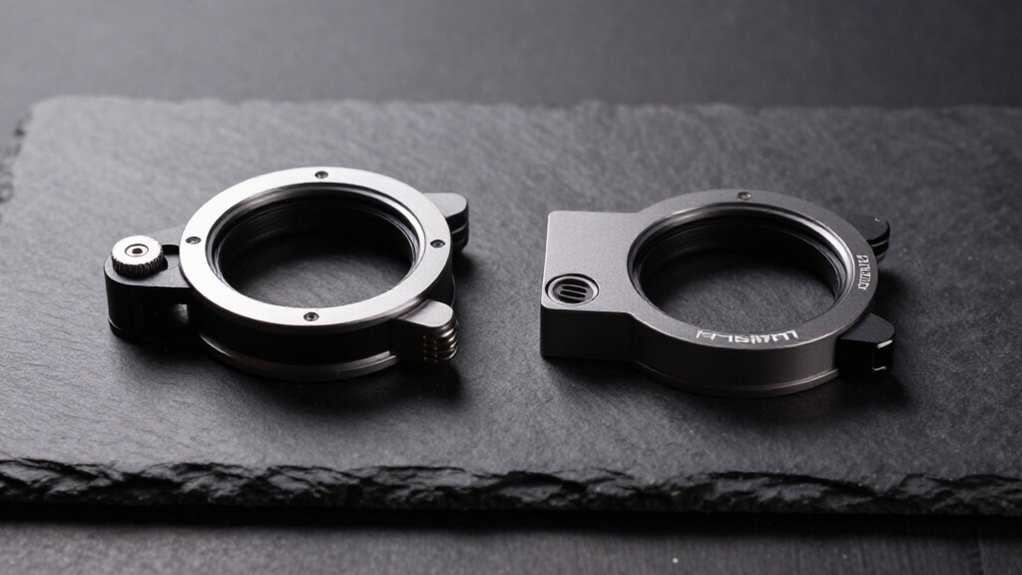
Arca-Swiss wins if you need broad plate compatibility and adjustable positioning; its 45-degree, roughly 38-mm dovetail supports many accessories, though you must align and tighten a screw clamp.
Manfrotto RC2 suits fast remounts: you press the plate into place and lock the lever, with a tested operation near 1.8 seconds.
But its exposed lever and grit-sensitive mechanism demand care. Mismatched profiles can rock, so expect dedicated plates.
More detail can help you choose confidently here.
RC2 Locking Lever Safety
Although the Manfrotto RC2 locks quickly, its lever needs attention: pressing the plate down drives a pin that engages the clamp, so you don’t have to tighten it by hand as you do with an Arca clamp.
You gain fast engagement without twisting a clamp, but the lever remains an exposed control. Close the secondary lock before shooting. Compared with Arca’s slower hand-tightening workflow in that test, RC2’s speed doesn’t remove the need for inspection and handling.
| Check | RC2 implication |
|---|---|
| Secondary lock | Close it for tighter retention and to prevent unintended opening. |
| Speed | One test recorded 1.8 seconds, versus 4.2 for Arca. |
| Lever hazard | Cold gloves can deploy the flip lever mid-shoot. |
| Contamination | Sand contributed to release at about 12 lb; keep area clean. |
Arca Dovetail Rail Profile
Arca-Swiss clamps use a 45° dovetail profile, typically about 38 mm wide, that must match the plate’s rails for even contact and secure clamping.
That geometry gives you a broad mating surface when the plate and clamp share the same cut. Arca clamps generally tighten with a screw knob, so you need to align the rails carefully before tightening for full contact. By contrast, RC2’s roughly 25° profile and narrower width use a different interface; a plate from one system won’t seat correctly in the other.
If you pair mismatched parts, you may see rocking or small gaps rather than an even fit. Check the specified profile and width when choosing plates or clamps. This dimensional distinction matters more than a similar appearance: matching rails let the clamp contact the plate as designed and provide predictable clamping geometry. For compatibility with RC2, select its plate.
Clamp Retention Under Load
Matching rail geometry is only part of the equation; retention under load depends on how each clamp locks the plate.
With RC2, you push the plate into place, then a lever-driven piston locks it; a secondary pin can help prevent accidental release under load if the lever isn’t fully engaged.
One test saw an RC2 clamp release when sand contaminated its mechanism during a single reported load test under a roughly 12-pound load.
Arca clamps instead depend on screw pressure and alignment, so you must tighten the screw enough to eliminate movement and prevent plate creep. Mismatched profiles can leave a 0.3 mm gap under lateral force, weakening retention despite a seated feel. Matched Arca plates hold securely with careful tightening, but demand precision.
Glove-Friendly Lever Operation
With gloves on, RC2’s lever can lock or release a plate in about 1.8 seconds, compared with roughly 4.2 seconds to turn an Arca-Swiss knob about three times and align the plate. The RC2’s piston engages its lever when you press the camera down; you then use the small security lock. That motion is quick, but the exposed lever can catch on cold gloves or get pressed accidentally during a shoot.
- You get retention from the internal pin behavior.
- You tighten Arca-Swiss’s clamp with a screw knob, over three turns.
- That slower adjustment can help you manage alignment deliberately.
- Keep the RC2 lever and safety clean: grit has caused spontaneous release at about 12 pounds of load in testing.
Neither approach eliminates handling risk.
Plate Fit for L-Brackets
L-bracket fit depends on clamp geometry: Arca-Swiss uses a 45° dovetail, typically about 38 mm wide, while Manfrotto RC2 commonly uses a 25° profile about 41 mm wide. Because an L-bracket leaves little contact area, you may find that mismatched angles prevent full seating; under lateral load, a plate can rock and leave roughly a 0.3 mm gap.
RC2 brackets also require the correct side and angle: its lever-and-cam clamp may hold a Manfrotto-shaped base only when you orient it properly. Arca’s open-sided clamp lets you slide the rail and tighten it at different positions, so you can align the camera precisely for portrait framing. That flexibility depends on firm clamp contact, though. With a heavy setup, use anti-rotation screws and verify the clamp is secure. Check fit before mounting your camera and lens.
Replacement Plate Availability
Once you’ve confirmed a plate fits securely, consider how easily you can replace or add plates later.
RC2 parts are common because it’s one of the most-used standards. A Rapid Connect Adapter with a 200PL-14 plate costs about $42, and each additional plate runs roughly $18. That keeps expansion economical when you equip several bodies.
- RC2’s use makes replacements straightforward to source.
- Arca-Swiss plates are also widely available, but camera-specific options can cost around $65 each.
- Its open standard supports ecosystem growth as you add bodies and lenses.
- Check clamp and plate matching carefully; some third-party combinations don’t fit or lock reliably.
Plate System Switching Costs
Switching from RC2 to Arca-Swiss involves more than replacing the clamp: the different dovetail angles and plate widths mean you’ll usually need new plates for every camera and lens. Arca’s 45-degree dovetail and roughly 38 mm width differ from RC2’s 25-degree profile and 41 mm width, so an adapter may not clamp securely. A reported 0.3 mm gap under lateral force illustrates how mismatched geometry can introduce play under load.
You’ll also need to check plate retention: RC2 provides built-in stops, while Arca’s open sides may call for anti-rotation screws on heavier lenses. That adds setup changes beyond the head receiver. Moving in either direction can leave compatible gear idle; consider your full camera-and-lens inventory and how often you swap supports.
Used RC2 components may also lose upgrade value faster, while Arca parts can remain useful across future setups. Check each clamp-and-plate combination before carrying a loaded rig, especially when changing systems.
Plate Price Comparison
When you price a three-camera setup, an Arca-Swiss clamp and plates can total about $305, compared with roughly $78 for Manfrotto RC2. Additional Arca-Swiss plates cost more, and some open-sided designs may require anti-rotation screws for heavy lenses.
RC2 costs less upfront, while Arca-Swiss may offer greater long-term value if you expand into its broader ecosystem or use the used market.
Plate Price Comparison
Although the initial setup favors different costs, Manfrotto RC2 is much cheaper to expand across multiple camera bodies in these examples: its adapter with a plate costs about $42, with additional plates around $18 each, while an Arca-Swiss plate costs about $65.
- For one body, you pay $42 to start with RC2; compare that bundled entry point with Arca-Swiss pricing, where the cited plate alone is $65.
- For three bodies, the examples put an Arca-Swiss clamp and three plates at about $305, versus roughly $78 for RC2.
- That gap reflects the different add-on rates, not a universal quote; your choices may change totals.
- If you’re equipping several bodies, RC2’s lower plate price can make each additional camera less expensive to outfit; compare components before buying.
Long-Term System Costs
Upfront prices don’t tell the whole story: the examples put three-body setups at about $78 for RC2 and $305 for Arca-Swiss, but those totals depend on the components and plates you buy.
With RC2, the roughly $42 adapter includes one 200PL-14 plate; each added plate costs about $18, so adding bodies drives the bill. Arca-Swiss’ example bundles a Neewer clamp with three plates for about $110, then charges around $65 for each additional plate.
Yet you may spread Arca plates across multiple supports, making that system less costly as your kit grows. Open-sided plates can require $25 safety screws, increasing your budget. Resale also matters: broader adoption may help Arca gear retain value, while RC2 parts may depreciate faster; the cited example estimates about 40%.
Travel Tripod Packing Convenience
When you pack a travel tripod, compare how each plate’s folded profile affects the tripod’s packed bulk. RC2’s lever lock can speed attachment without screw turns, while Arca’s clamp may require several.
Your choice also depends on whether Arca’s adjustable plate length suits your kit enough to justify carrying any extra components.
Folded Plate Profile
For travel, Arca-Swiss plates offer adjustable positioning along their longer dovetail rails, but that length can take up more space in a packed bag than a standard Manfrotto RC2 plate. By contrast, an RC2 plate uses a snap-in shape matched to the base’s lever-and-pin action; on common heads, that profile is often shorter.
Exact folding clearance depends on the model, so check the plate and clamp together rather than assuming either system lies flat.
- Choose Arca-Swiss when sliding adjustment lets you reposition the clamp without changing plates.
- Choose RC2 for standard foot layouts; its snap-in retention may reduce separate carry-on parts.
- Check model-specific folding clearance between plate and clamp before travel.
- For heavy Arca setups, confirm anti-rotation support suits your load and bag space.
Packed Tripod Bulk
If you’re packing and unpacking often, RC2’s one-hand lever-and-piston release can speed handling and limit extra retention hardware; cited tests measured 1.8 seconds for RC2 versus 4.2 seconds for an Arca-Swiss screw clamp. That timing matters on travel days, but packed bulk depends more on the plates and adapters you carry.
RC2’s familiar geometry can let you use one plate across many stills setups, reducing spares; camera-specific needs may still add RC2 plates or adapters. Arca-Swiss rails slide within a clamp, so you can reposition compatible plates rather than pack different clamps, and varied rail lengths can stow neatly.
However, open-sided retention and heavier lenses may call for anti-rotation screws, while matching plate sizes can increase your kit. Choose RC2 if your cameras share its ecosystem and you want fewer loose parts. Choose Arca if rail compatibility suits your gear, and you’ll manage plate sizing deliberately. Compare your packed kit, not just clamp dimensions and accessory count.
Quick-Release Convenience
How quickly can you remount a camera between travel stops? For packing and setup, RC2 offers a faster sequence: orient the plate, press down, and let the lever lock. An Arca-style clamp typically needs about three turns after you place or slide the plate, then tighten it to remove play.
Timing comparisons report roughly 1.8 seconds for RC2 versus 4.2 for Arca, useful when you repeat mounts throughout a trip.
- Choose RC2 when rapid, repeatable attachment matters most.
- Choose Arca when you share gear across tripods or accessories.
- Check RC2’s security protrusion; it may keep the base from lying flat.
- Consider Arca’s modular plate lengths for varied packing and mounting surfaces.
Your travel option depends on whether speed outweighs ecosystem compatibility and storage flexibility.
Video Head Pan Control
On a video head, Arca-Swiss plates let you loosen the clamp and slide the camera for fine balance without removing it, but their screw clamps take more precise handling, about 4.2 seconds to attach in the timing comparison. By contrast, RC2’s push-down lever locks in about 1.8 seconds, so you can re-center quickly during pan adjustments. Arca-Swiss gives you fore-aft positioning while the camera remains mounted, helping you balance a rig before panning.
If you use a gimbal or change mounts, check whether you need a long Arca-Swiss plate for smooth motion. Don’t assume the systems interchange: Arca’s 45-degree angle and 38mm width differ from RC2’s 25-degree angle and 41mm width. A mismatch can prevent proper seating and undermine stable pan control.
Conclusion
You’ll get faster, glove-friendly releases from Manfrotto RC2, but its lever lock and proprietary plates limit compatibility. Arca-Swiss offers a standardized dovetail profile, broad L-bracket support, and dependable clamping under load, though switching systems can add cost.
For travel, compare plate bulk and your tripod’s packing needs; for video, prioritize the head’s pan control, not the plate alone. Choose RC2 for an existing Manfrotto setup, or Arca-Swiss for flexibility across gear.